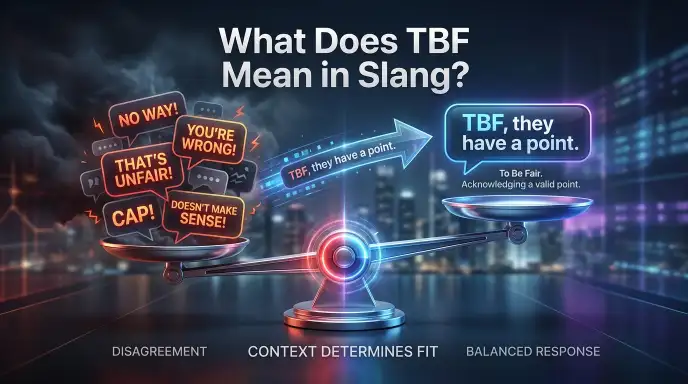
You may see TBF in a text, comment, or social media post and wonder what the letters mean. In slang and online communication, TBF usually means “to be fair.” It is used when someone wants to point out another side of a situation, admit a good point, or make a statement more balanced.
For example, if someone says, “Jake was late,” another person might reply, “TBF, nobody told him the time changed.” The speaker is not fully defending Jake. They are simply adding a fair point.
TBF is popular because it is short and easy to type. You may see it in text messages, Reddit discussions, TikTok comments, Instagram posts, Discord chats, and other casual online spaces. Understanding the tone is important too. TBF is usually neutral and friendly, not rude or offensive.
Quick Answer Table
| Question | Answer |
| TBF meaning | To be fair |
| Type | Texting abbreviation / internet slang |
| Tone | Neutral, casual, balanced |
| Used By | People in casual online communication |
| Common Platforms | Texting, Reddit, TikTok, Instagram, Discord, X |
| Offensive? | No, normally not |
| Main Purpose | To add a fair or balanced point |
| Example | “TBF, she tried her best.” |
One useful detail is that TBF does not always mean the speaker agrees with the person being discussed. It often introduces a point that deserves consideration. That makes it different from simple agreement words such as “yes” or “exactly.”
What Does TBF Mean in Slang?
TBF means “to be fair.”
People use it when they want to acknowledge a fact that may have been overlooked.
For example:
“The movie was really long.”
Someone might respond:
“TBF, the story had a lot to explain.”
The second person is giving a fair reason for the movie’s length.
Another example:
“Sam messed up the presentation.”
“TBF, he only had one day to prepare.”
Here, TBF introduces another side of the situation.
The abbreviation can appear at the beginning, middle, or sometimes near the end of a message, but it is most natural at the beginning of a sentence.
What Is the Full Form of TBF?
The most common full form of TBF is “to be fair.”
It is an abbreviation made from the first letters of the phrase:
- T = To
- B = Be
- F = Fair
It works in much the same way as other texting abbreviations such as TBH (“to be honest”) and IMO (“in my opinion”).
The exact meaning can depend on context, but “to be fair” is the standard meaning in everyday texting and internet slang.
What Does “To Be Fair” Mean?
The phrase “to be fair” means that you want to consider a point honestly or give someone credit for something.
It often appears when a conversation is one-sided.
For example:
“Maria forgot the meeting.”
“TBF, she wasn’t told about the new time.”
The first sentence gives one fact. The second speaker adds information that makes the situation more balanced.
TBF can therefore signal:
- A fair point
- A different side of a story
- A defense of someone
- Recognition of someone’s effort
- A correction to an unfair judgment
It does not always mean the speaker completely disagrees with the original statement.
How Do You Pronounce TBF?
TBF can be pronounced in two ways.
In casual texting, people usually understand it as the letters “T-B-F.”
You can say:
“tee bee eff.”
When reading the full meaning aloud, you would simply say:
“to be fair.”
Unlike some slang words, TBF is mainly a written abbreviation. People are more likely to type it than say “TBF” aloud in normal conversation.
Where Did TBF Come From?
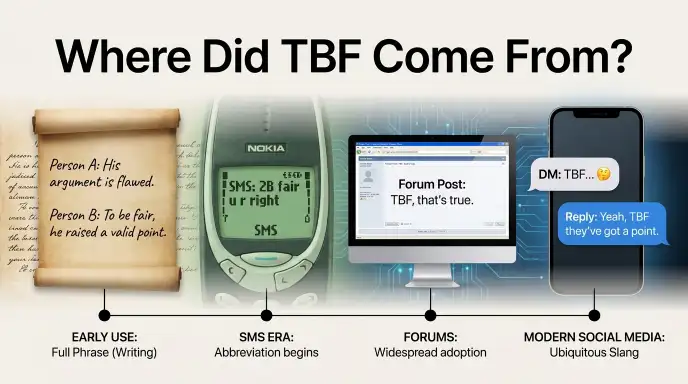
TBF comes from the phrase “to be fair,” which existed long before internet slang. The abbreviation developed as part of the broader habit of shortening common phrases in digital communication.
Texting and online chats encouraged people to use short forms because they are quick to type. TBF became a convenient way to introduce a balanced point without writing the entire phrase.
It is difficult to give one exact date or person responsible for creating the abbreviation. It is better to describe it as a common internet and texting abbreviation rather than claim that one person invented it.
The phrase itself is much older than the abbreviation. TBF is simply the shortened digital form of a normal English expression.
Why Do People Use TBF?
People use TBF because it lets them add nuance without writing a long explanation.
Imagine a group chat where everyone is criticizing a friend:
“Liam was so slow today.”
“He forgot the instructions.”
“He didn’t finish the task.”
Another person might write:
“TBF, nobody explained what he was supposed to do.”
That short abbreviation changes the direction of the conversation. It signals that the speaker wants people to consider another fact.
TBF can be useful when someone wants to:
- Defend another person
- Admit that someone has a good point
- Make criticism more balanced
- Add missing context
- Correct an unfair opinion
- Acknowledge a positive detail
Where Is TBF Used?
TBF can appear on many online platforms because its meaning does not normally change from one platform to another.
| Platform | Common Use | Example |
| Texting | Adding a fair point | “TBF, he did apologize.” |
| TikTok | Responding to a video or opinion | “TBF, she had a good reason.” |
| Adding context to a post | “TBF, that photo was from years ago.” | |
| Giving another side of an argument | “TBF, the update fixed several issues.” | |
| Discord | Balancing a group discussion | “TBF, he warned us first.” |
| X | Adding nuance to a debate | “TBF, that part is true.” |
| Casual group-chat discussion | “TBF, we all agreed to it.” | |
| YouTube | Replying to someone’s opinion | “TBF, the creator explained why.” |
The abbreviation is most natural in informal communication. You may see it more often in writing than in spoken English.
What Does TBF Mean in Texting?
In texting, TBF means “to be fair.”
It usually introduces a thought that makes a conversation more balanced.
For example:
Ava: “Tom never helps with group projects.”
Noor: “TBF, he did most of the research this time.”
Noor is not necessarily saying Ava is completely wrong. She is pointing out something that should also be considered.
You can use lowercase too:
“tbf, that was a pretty good idea.”
TBF and tbf have the same meaning. Capitalization usually does not change the meaning in casual texting.
TBF on Social Media
On social media, people often use TBF when responding to another person’s opinion.
For example:
“Everyone says this restaurant is terrible.”
A comment might say:
“TBF, I went last week and the service was great.”
The commenter is adding a different experience rather than simply attacking the original opinion.
On platforms with short comments, TBF is useful because it quickly signals that the writer is about to make a balanced point.
It can also appear in playful comments:
“TBF, you did tell us not to touch it 😂”
Here, the phrase can sound teasing while still admitting that the other person was right.
Is TBF Formal or Informal?
TBF is informal.
It is suitable for:
- Text messages
- Social media
- Group chats
- Online discussions
- Gaming chats
- Casual emails between friends
It is usually better to write “to be fair” in:
- Academic essays
- Formal reports
- Business documents
- Job applications
- Professional presentations
For example, instead of:
“TBF, the results were better than expected.”
A formal version would be:
“To be fair, the results were better than expected.”
The meaning stays the same. Only the level of formality changes.
Does TBF Mean Something Different Depending on Context?
The main meaning of TBF stays “to be fair,” but its tone can change.
It can be:
Supportive:
“TBF, she worked really hard.”
Balanced:
“TBF, both teams made mistakes.”
Defensive:
“TBF, he wasn’t given enough time.”
Playful:
“TBF, you did eat the whole pizza.”
So when you see TBF, look at the sentence that follows it. That usually tells you why the person thinks a fair point needs to be added.
TBF vs. TBH
TBF and TBH are easy to confuse because both are common texting abbreviations.
| Abbreviation | Full Form | Meaning |
| TBF | To be fair | Adds a balanced or fair point |
| TBH | To be honest | Introduces an honest opinion |
| IMO | In my opinion | Gives a personal opinion |
| FYI | For your information | Gives useful information |
For example:
TBF: “He was tired, so I understand why he left.”
TBH: “I didn’t enjoy the party.”
TBF focuses on fairness or context. TBH focuses on honesty or personal opinion.
Is TBF Positive or Negative?
TBF is usually neutral. It does not automatically show that someone agrees or disagrees.
The tone depends on the point that comes after it.
For example:
“TBF, she did a great job.”
This sounds positive because the speaker is giving her credit.
But:
“TBF, that was a terrible decision.”
Here, TBF introduces a fair point while the overall statement remains negative.
The abbreviation itself is mainly a way to make a comment more balanced.
Is TBF Rude or Offensive?
No, TBF is not normally rude or offensive.
It is a common casual abbreviation used to add another side to a discussion. Still, the sentence around it can sound critical.
For example:
“TBF, you didn’t follow the instructions.”
This may sound direct, but TBF itself is not offensive.
In a sensitive conversation, the full phrase “to be fair” can sometimes sound more polite than the abbreviation because it feels less casual.
Can TBF Be Used by Adults?
Yes. TBF is not limited to teenagers or Gen Z.
Adults commonly understand the phrase because it comes from the normal English expression “to be fair.”
You can use it in casual:
- Text messages
- Group chats
- Social media comments
- Online discussions
- Gaming chats
The main thing to remember is that TBF is informal writing. It is better to write the full phrase in professional or academic settings.
Is TBF Still Used?
Yes, TBF remains a recognizable texting and internet abbreviation.
Its use is not limited to one social platform. People may use it in private chats, online discussions, comments, and other informal spaces.
However, slang and texting habits vary. Some people prefer writing “to be fair” instead of using the abbreviation. Others use TBF because it is faster.
So you should not assume that every person uses TBF regularly. Its meaning is more stable than its popularity among different groups.
TBF vs. Similar Texting Abbreviations
Several abbreviations can look similar to TBF but serve different purposes.
| Abbreviation | Full Form | Main Meaning |
| TBF | To be fair | Adds a balanced point |
| TBH | To be honest | Gives an honest opinion |
| IMO | In my opinion | Shares a personal view |
| IMHO | In my humble opinion | Gives a personal view, often casually |
| FR | For real | Shows agreement or seriousness |
| NGL | Not gonna lie | Introduces an honest comment |
A simple way to remember them is:
TBF = a way to acknowledge fairness
TBH = a way to express honestyIMO = a way to share your opinion
TBF vs. TBH
TBF means:
“To be fair…”
It normally adds balance or another side.
TBH means:
“To be honest…”
It normally introduces a personal or honest opinion.
Compare these examples:
“TBF, he gave us plenty of time.”
“TBH, I didn’t enjoy the movie.”
The first sentence gives context. The second gives an opinion.
TBF vs. IMO
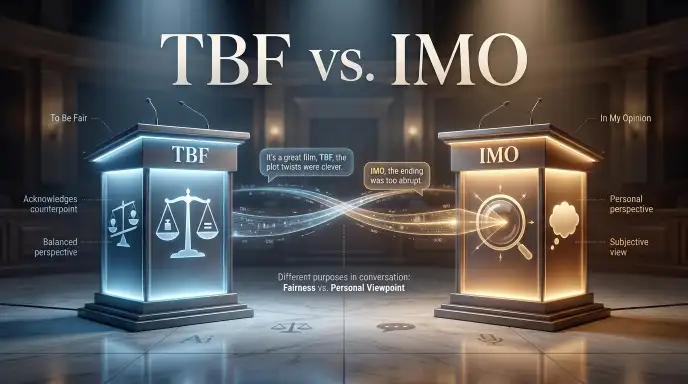
IMO means “in my opinion.”
It tells readers that the statement is the speaker’s personal view.
For example:
“IMO, this is the best game in the series.”
TBF works differently:
“TBF, the new game has better graphics.”
The first expresses a personal opinion. The second acknowledges a fair or positive point.
When Should You Use TBF?
Use TBF when you want to add information that makes a conversation more balanced.
It works well when:
- Someone is being criticized unfairly.
- You want to admit that another person has a good point.
- A story needs more context.
- You want to correct a one-sided opinion.
- You want to give someone credit.
- You agree with part of an argument but not all of it.
For example:
“The restaurant was expensive.”
“TBF, the portions were huge.”
The second speaker is not saying the restaurant was cheap. They are simply adding a fair point.
When Should You Avoid Using TBF?
Avoid TBF when the setting is formal and professional.
For example, this may look too casual in a work report:
“TBF, the team finished the project early.”
A better version is:
“To be fair, the team finished the project early.”
You should also avoid using the abbreviation when the reader may not understand texting slang.
In formal writing, clarity matters more than saving a few characters.
Common Mistakes With TBF
Mistake 1: Thinking TBF Means “to be honest”
TBF and TBH are different.
TBF = to be fair
TBH = to be honest
They can appear in similar conversations, but they introduce different ideas.
Mistake 2: Thinking TBF always means agreement
TBF does not mean “I agree.”
Someone can use it while disagreeing with most of a statement.
For example:
“I don’t think the plan will work. TBF, the idea itself is creative.”
The speaker disagrees with the plan but still gives credit to the idea.
Mistake 3: Assuming TBF is offensive
TBF itself is not offensive. The sentence that follows it determines the tone.
Mistake 4: Using TBF in every message
The abbreviation is useful, but overusing it can make writing sound repetitive.
Use it when you genuinely want to add a fair point.
Mistake 5: Assuming everyone knows the abbreviation
Some people may not know texting abbreviations. If your audience is unfamiliar with internet slang, simply write “to be fair.”
Real Life TBF Examples
Group Chat
Zain: “Nobody helped with the project.”
Omar: “TBF, Sara did most of the research.”
Omar is adding information that changes the picture. He is not fully defending everyone, but he thinks Sara deserves credit.
Social Media Comment
Post: “This update ruined the app.”
Comment: “TBF, the new search feature is much better.”
The commenter acknowledges a criticism while pointing out a positive change.
Gaming Chat
Alex: “Our team lost because Ben played badly.”
Chris: “TBF, he was playing with a broken mouse.”
Chris is giving context for Ben’s performance.
Everyday Conversation
Nadia: “My brother never listens to me.”
Hiba: “TBF, you didn’t tell him about the plan.”
Hiba thinks Nadia may have a fair complaint, but she also points out something Nadia overlooked.
What Does TBF Mean in a Sentence?
Here are some natural examples:
- “TBF, you had a good reason.”
- “TBF, the second option is cheaper.”
- “TBF, nobody warned him.”
- “TBF, she tried her best.”
- “TBF, I understand why he was upset.”
- “TBF, the old version was easier to use.”
In each example, TBF introduces a point that adds fairness, context, or balance.
Key Takeaways
- TBF means “to be fair.”
- It is a common texting and internet abbreviation.
- People use it to add a fair, balanced, or overlooked point.
- TBF is normally neutral, not offensive.
- TBF is different from TBH, which means “to be honest.”
- It is best for casual communication, not formal writing.
- The meaning stays the same across most platforms, but the tone depends on context.
FAQs
Q1. What Does TBF Mean in Slang?
In slang and online conversations, TBF usually means “to be fair.” People use it to add a fair point, explain another side, or soften what they just said.
Q2. What Does “TBF” Mean in Text?
In texting, TBF means “to be fair.” It is a quick way to introduce a balanced opinion or acknowledge something that is true.
Q3. What Is TBF Full Form?
The most common full form of TBF in texting and social media is “to be fair.” It is widely used in casual chats, comments, and online discussions.
Q4. Is TBF “To Be Fair”?
Yes. TBF commonly stands for “to be fair.” For example, “TBF, she did warn us” means “To be fair, she did warn us.”
Q5. What Does TBF Mean on Snapchat?
On Snapchat, TBF usually means “to be fair.” Friends may use it in messages or captions when giving another perspective or making a balanced comment.
Q6. Why Does TBF Stand For?
TBF stands for “to be fair” because it is an abbreviation formed from the first letters of the three words. It makes casual online communication faster and shorter.
Q7. What Does “TBF” Mean on Instagram?
On Instagram, TBF usually means “to be fair.” You may see it in comments, captions, DMs, and replies when someone wants to acknowledge another side of an argument or situation.
Conclusion
TBF means “to be fair” in texting and internet slang. People use it to add balance, context, or another side to a conversation. It can show that someone deserves credit, that a criticism is not completely fair, or that an overlooked fact should be considered.
TBF is different from abbreviations such as TBH and IMO. TBH introduces an honest opinion, while IMO marks a personal view. TBF focuses on fairness or balance.
You can use TBF naturally in texts, social media comments, group chats, gaming conversations, and other casual settings. For formal writing, it is better to write “to be fair” in full.
Once you know this meaning, phrases such as “TBF, he tried” or “TBF, she had a point” become easy to understand. The key idea is simple: TBF tells you that the speaker is adding a fair point to the conversation.
Continue Your Slang Journey!
What Does “That’s Cap” Mean in Slang? Definition,Uses, Examples
NY Slang Words: Meanings, Uses, and Real Life Examples
What Does PTSO Mean in Slang? Definition, Uses, and Examples

I am Masson Caldwell, a language enthusiast and content writer at SlangAura. I write about internet slang, texting trends, and modern expressions to help readers understand the evolving world of online language with simple and clear explanations.