You may have seen someone comment “That’s cap” after a person made a bold claim online. If you are not familiar with slang, the phrase can be confusing because cap normally means a type of hat. In slang, however, “that’s cap” means that something is not true, exaggerated, or hard to believe.
People often use the phrase in text messages, TikTok comments, Instagram posts, Discord chats, YouTube comments, and casual conversations. It can be playful between friends. It can also sound more serious when someone uses it to question another person’s honesty.
The phrase is closely linked to “no cap,” which means “for real” or “no lie.” Once you understand these two expressions, many online conversations become much easier to follow.
Quick Answer Table
| Question | Answer |
| Meaning | That is not true, or I don’t believe it |
| Tone | Casual, doubtful, teasing, or direct |
| Used By | Mostly people familiar with modern internet slang |
| Platforms | TikTok, Instagram, Snapchat, Discord, Reddit, YouTube, texting |
| Offensive? | Usually no, but it can sound rude in a serious situation |
| Opposite | “No cap” means for real or no lie |
| Emoji | 🧢 is commonly used to represent “cap” |
The important point is that cap does not always mean a deliberate lie. It can also describe an exaggerated story, a boast, or a claim that sounds unrealistic. The context helps show how strongly the speaker means it.
What Does “That’s Cap” Mean?
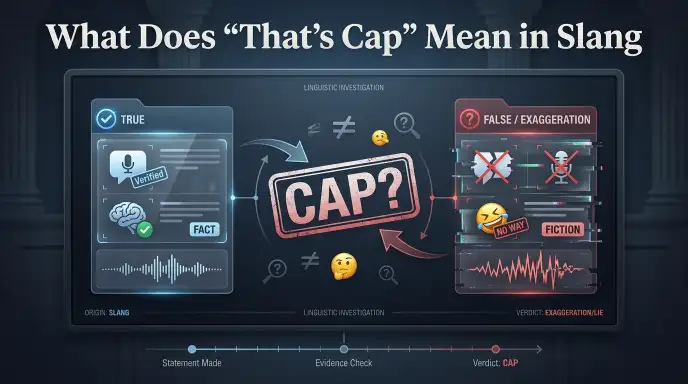
“That’s cap” means “that’s not true,” “that’s a lie,” or “I don’t believe you.”
Someone may use it after hearing a claim that seems impossible or exaggerated.
For example:
“I finished the whole assignment in five minutes.”
A friend might reply:
“That’s cap.”
The friend is saying that the claim does not sound believable.
The phrase can also be shortened to simply “cap.”
For example:
“I have never lost a game.”
“Cap.”
Here, “cap” works as a quick way to say, “I don’t believe you.”
Cap Can Mean More Than a Lie
The word can point to several types of doubtful statements:
- A lie
- An exaggeration
- A boast
- An unbelievable claim
- Something that is not accurate
This is why “that’s cap” does not always accuse someone of intentionally lying. Sometimes it simply means that their story sounds too extreme to believe.
How Do You Pronounce “That’s Cap”?
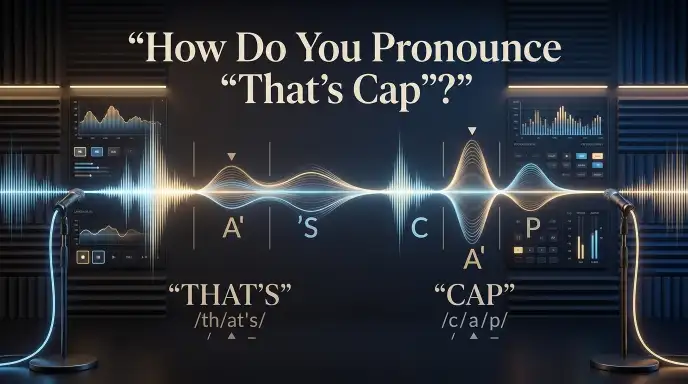
“That’s cap” is pronounced:
/ðæts kæp/
The word cap sounds like “kap.” It rhymes with words such as:
- Map
- Tap
- Snap
- Wrap
In casual speech, the phrase is usually said quickly.
That’s cap.
The word “that’s” is a short form of “that is.”
Where Did “That’s Cap” Come From?
The modern slang use of cap has roots in African American English. It was not created by TikTok, even though social media helped spread the phrase to a much wider audience.
Merriam Webster explains that the slang sense of cap developed in African American English and became connected with ideas such as lying, boasting, and exaggeration. The expression later became strongly associated with hip-hop culture.
The exact origin of the slang is not completely settled. Older uses of capping appear in African American speech and culture, while the expression became much more visible through hip-hop and later internet culture.
That history matters because it is easy to assume that modern slang begins on social media. In this case, TikTok and other platforms helped popularize an expression that was already in use.
How Did “Cap” Become Popular Online?
Hip-hop played an important role in spreading cap, capping, and no cap beyond their earlier communities.
Later, social media gave these expressions a much larger audience. Short comments such as “cap,” “that’s cap,” and “no cap” work well online because they communicate a strong reaction with very few words.
The phrase became especially easy to recognize in:
- Social media comments
- Memes
- Text messages
- Gaming chats
- Online discussions
- Short-form videos
Its popularity does not mean every person uses it. Slang varies by age, community, region, and personal style.
“That’s Cap” vs. “No Cap”
“That’s cap” and “no cap” have opposite meanings.
| Expression | Meaning | Example |
| That’s cap | I don’t believe that | “You finished that in two minutes? That’s cap.” |
| Cap | A lie or exaggerated claim | “That story is cap.” |
| You’re capping | You are lying or exaggerating | “You’re capping right now.” |
| Stop capping | Stop lying or exaggerating | “Stop capping about your score.” |
| No cap | For real; no lie | “That was amazing, no cap.” |
Merriam-Webster defines “no cap” as an expression used to emphasize that someone is telling the truth or being serious.
A simple way to remember the difference is:
Cap = not true.
No cap = true / for real.
Where Is “That’s Cap” Used?
The meaning stays mostly the same across social platforms, so the phrase does not need a different definition for every app.
| Platform | How It Is Used | Example |
| TikTok | Calling out an unbelievable claim | “You did that first try? That’s cap.” |
| Reacting to an exaggerated post | “You made all that in one day? Cap.” | |
| Snapchat | Doubting a friend’s story | “You really saw him there? That’s cap 😂” |
| Discord | Challenging a claim in a group chat | “You got 20 wins today? That’s cap.” |
| Showing doubt about a story | “That sounds like cap to me.” | |
| YouTube | Responding to claims in comments | “That’s cap. Show us the proof.” |
| Casual reaction in private chats | “Nah, that’s cap.” | |
| X | Calling out a questionable claim | “That’s cap and you know it.” |
The phrase is especially natural in informal communication. It may feel out of place in professional emails, academic writing, or formal conversations.
Does “That’s Cap” Mean Someone Is Lying?
Not always.
The phrase can mean that someone is lying, but it can also show doubt about an exaggerated claim.
Consider this example:
“I can run 10 miles in 30 minutes.”
Someone might respond:
“That’s cap.”
They may not know for certain that the person lied. They are simply saying that the claim sounds unbelievable.
This makes “that’s cap” more flexible than simply saying “you are lying.”
The difference can be small, but it changes the tone. “You’re lying” is a direct accusation. “That’s cap” can sound more playful or informal.
Is “That’s Cap” Formal or Informal?
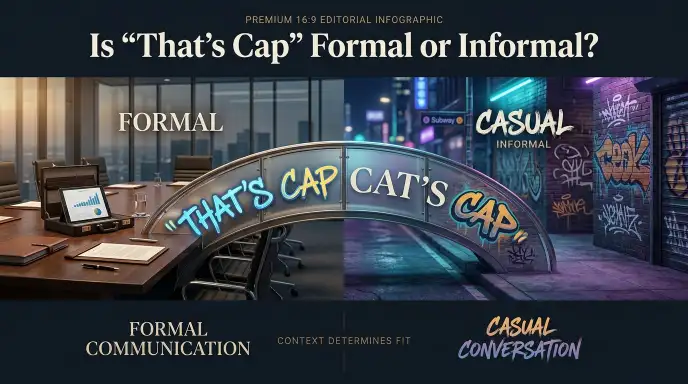
“That’s cap” is informal slang.
It works well in:
- Text messages
- Casual conversations
- Social media
- Gaming chats
- Memes
- Friendly group chats
It is usually not suitable for:
- School essays
- Business reports
- Job applications
- Formal emails
- Academic papers
- Professional presentations
For formal situations, you can use phrases such as:
- “That does not seem accurate.”
- “I don’t believe that claim is correct.”
- “That sounds unlikely.”
- “I think that information may be wrong.”
These options communicate doubt without using slang.
Is “That’s Cap” Positive or Negative?
The phrase “that’s cap” is usually negative toward the statement. It tells someone that you do not believe what they said.
For example:
“I got the highest score in the whole school.”
“That’s cap.”
The speaker is questioning the claim.
Still, the phrase is not always meant to start an argument. Friends often use it as a joke when someone makes a wild claim.
The topic and tone matter. A laughing emoji can make the phrase feel playful. A serious reply can make it sound like a real accusation.
Is “That’s Cap” Rude or Offensive?
“That’s cap” is not normally considered offensive, but it can sound rude.
The reason is simple: you are telling someone that you do not believe them.
Among close friends, this may be harmless teasing:
“I ate six burgers last night.”
“Bro, that’s cap 😂”
In a serious conversation, the same phrase may feel disrespectful.
If someone is talking about money, work, relationships, or another sensitive subject, it is better to choose softer words.
You could say:
- “Are you sure?”
- “Really?”
- “I’m not sure about that.”
- “That sounds hard to believe.”
- “Do you have proof?”
These phrases let you question a claim without directly calling someone a liar.
What Does the 🧢 Emoji Mean in Slang?
The 🧢 baseball cap emoji is often used online to represent “cap.”
When someone replies with only:
🧢
they may mean:
“That’s a lie.”
They may also be saying:
“I don’t believe you.”
For example:
Post: “I made $5,000 from one video.”
Reply: “🧢”
The emoji gives the same basic reaction as “That’s cap.”
You can also see:
“No 🧢”
This usually means “no lie” or “I’m being serious.”
The emoji works because the slang word cap and the ordinary object, a cap or hat, are represented by the same idea.
Real Life Examples of “That’s Cap”
Text Message
Layla: “I finished my entire assignment during lunch.”
Sami: “That’s cap 😭”
Sami thinks Layla probably spent more time on the assignment. The phrase is playful because the conversation is between friends.
TikTok Comment
Video caption: “I learned this whole dance in five minutes.”
Comment: “That’s cap 😂”
The commenter doubts the claim. The laughing emoji makes the response feel more like teasing than an angry accusation.
Discord Chat
Marcus: “I won the match without taking any damage.”
Dylan: “Bro, that’s cap.”
Dylan is questioning Marcus’s gaming claim. In a gaming chat, this type of slang can be a quick and casual reaction.
School Conversation
Hassan: “The teacher said the test is canceled.”
Bilal: “Wait, that’s cap. I just saw the study guide.”
Bilal does not believe the information because he has evidence that suggests something different.
Instagram Caption
Caption: “No one can beat my record.”
Comment: “Cap 🧢”
The commenter is challenging the boast. It may be friendly competition rather than a serious argument.
Casual Conversation
Tara: “He said he can run faster than every player on the team.”
Megan: “That’s cap.”
Megan thinks the statement is exaggerated. She is not necessarily saying that Tara’s friend is deliberately lying.
Why Do People Say “That’s Cap”?
People use the phrase because it is short, expressive, and easy to understand in casual conversation.
Instead of writing:
“I think the information you just gave me is probably not true.”
someone can simply write:
“That’s cap.”
The shorter version also adds attitude. Depending on the context, it can sound funny, doubtful, surprised, or challenging.
This makes it useful in fast-moving chats and comment sections.
Common Mistakes With “That’s Cap”
Mistake 1: Thinking “cap” only means a hat
In standard English, cap can mean a type of hat.
In slang, it can mean a lie, exaggeration, or doubtful claim.
You need to look at the sentence to understand which meaning is intended.
Mistake 2: Confusing “cap” with “no cap”
These expressions have opposite meanings.
That’s cap means:
“I don’t believe that.”
No cap means:
“I’m telling the truth.”
Mixing them up can completely change the meaning of a message.
Mistake 3: Assuming every “cap” is a serious lie
Someone can say “cap” as a joke.
A friend might exaggerate a story on purpose. Another friend may respond, “Cap 😂” without being genuinely angry.
The relationship between the speakers matters.
Mistake 4: Using it in formal writing
“That’s cap” is slang. It should not normally appear in an academic essay, formal report, or professional email.
Use clear standard English when the setting requires it.
Mistake 5: Using it without understanding the tone
Calling someone a liar can be sensitive.
If you are unsure how the other person will react, use a softer phrase such as “Really?” or “Are you sure?”
“That’s Cap” vs. Similar Slang
Some slang expressions have a similar meaning, but their tone is not always the same.
| Expression | Meaning | Typical Tone |
| That’s cap | I don’t believe that | Casual |
| Cap | That’s a lie or exaggeration | Very casual |
| You’re capping | You are lying or exaggerating | Direct |
| Stop capping | Stop lying or exaggerating | Direct |
| You’re lying | I think you are not telling the truth | More serious |
| No way | I find that hard to believe | Casual |
| For real? | Are you serious? | Casual |
“That’s cap” is often less formal than “you’re lying.” It can also focus on the claim instead of directly labeling the person as dishonest.
What Is the Opposite of “That’s Cap”?
The closest opposite is “no cap.”
When someone says “no cap,” they are stressing that they are telling the truth.
For example:
“That was the best meal I’ve ever had, no cap.”
This means:
“I really mean that.”
Another example is:
“No cap, I was there when it happened.”
The speaker is emphasizing that the story is genuine.
You may also see “fr”, short for “for real,” used in a similar way.
Can Adults Say “That’s Cap”?
Yes. Adults can use the phrase in casual settings.
There is no age rule that prevents someone from saying it. The main issue is context and natural use.
It may sound normal in a friendly group chat. It may sound strange in a business meeting.
You do not need to use slang just because other people use it. If the phrase fits your normal way of speaking, it can work well in informal conversations.
Is “That’s Cap” Still Used?
Yes, “cap” is still a recognized slang term. Major English dictionaries now record its slang meaning.
Cambridge Dictionary lists cap as slang for something that is not true. Merriam-Webster also records the slang use and explains its connection with African American English.
Its use can vary by age group, community, location, and online platform. Slang changes quickly, so not every speaker uses the phrase with the same frequency.
Even so, “cap,” “no cap,” and “that’s cap” remain widely recognizable expressions in modern informal English.
People Also Ask About “That’s Cap”
Q1. What does cap mean in slang?
In slang, “cap” means a lie or something that is not true. When someone says “That’s cap,” they are saying that they do not believe the claim.
Q2. What is cap in Gen Z slang?
In Gen Z slang, “cap” refers to a lie, false statement, or exaggeration. “No cap” is used when someone wants to show they are being honest.
Q3. What does “cap it” mean in slang?
“Cap it” generally means to stop lying, exaggerating, or making false claims. It can be used when someone thinks another person is not being truthful.
Q4. Why do kids say no cap?
Kids and teens use “no cap” to emphasize that they are telling the truth. It is similar to saying “for real,” “seriously,” or “I’m not lying.”
Q5. Does “no cap” mean no lie?
Yes, “no cap” means “no lie” or “I’m telling the truth.” It tells others that the speaker is being genuine and not exaggerating.
Q6. Who was the first person to say “no cap”?
There is no confirmed single person who invented “no cap.” The expression is linked to African American English and hip-hop culture before becoming widely popular through music and social media.
Key Takeaways
- “That’s cap” means “that’s not true” or “I don’t believe that.”
- It can describe a lie, exaggeration, boast, or doubtful claim.
- “No cap” means “for real” or “no lie.”
- The 🧢 emoji can be used to represent “cap.”
- The phrase is informal, so it is not ideal for professional or academic writing.
- It can be playful among friends but may sound rude in a serious discussion.
- The modern slang meaning has roots in African American English and later spread widely through hip-hop and internet culture.
Conclusion
“That’s cap” is a simple way to say that you do not believe something. It can mean that a statement is false, exaggerated, or simply too hard to accept. The phrase is common in informal conversations, texts, social media comments, gaming chats, and online communities.
It is also useful to understand the related expressions. “Cap” can describe a doubtful claim, while “capping” means lying or exaggerating. “No cap” is the opposite and tells someone that you are being honest or serious.
The phrase is not normally offensive, but the tone can change its effect. With friends, it may be a joke. In a serious discussion, it can sound like an accusation.
If you see “that’s cap,” “cap,” or 🧢 online, think “I don’t believe that.” That simple meaning will help you understand most uses of the expression.
Related Slang Terms:
NY Slang Words: Meanings, Uses, and Real Life Examples
What Does PTSO Mean in Slang? Definition, Uses, and Examples

I am Masson Caldwell, a language enthusiast and content writer at SlangAura. I write about internet slang, texting trends, and modern expressions to help readers understand the evolving world of online language with simple and clear explanations.