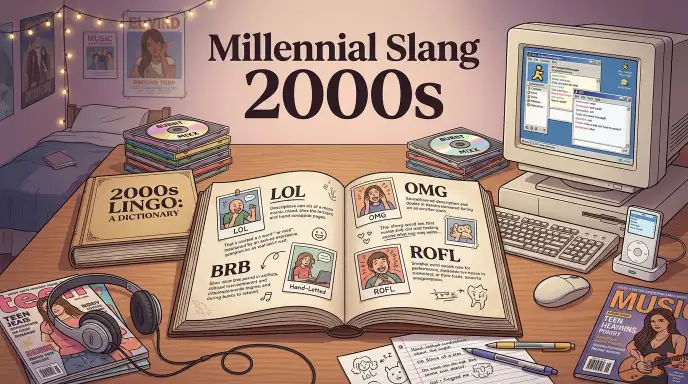
Millennial slang from the 2000s includes the casual words, abbreviations, texting shortcuts, and internet phrases that became popular among young people during the early days of AIM, MSN Messenger, MySpace, early Facebook, forums, and mobile texting. Terms such as LOL, BRB, OMG, TTYL, cool, awesome, sick, epic, and fo’ shizzle became part of everyday communication and helped shape modern internet language.
The 2000s were a major transition period. People were moving from face to face conversations and phone calls toward instant messages, text messages, social networks, and online communities. That change created a style of communication that feels nostalgic today but still influences how people write online.
Quick Answer: Millennial slang from the 2000s includes popular expressions such as LOL, BRB, OMG, TTYL, BFF, IDK, noob, epic, sick, legit, chill, and fo’ shizzle. Some are still common, while others are strongly associated with early internet culture and 2000s youth.
Quick Answer: Millennial Slang 2000s
| Quick Detail | Answer |
| Main topic | 2000s slang used by Millennials |
| Popular platforms | AIM, MSN Messenger, MySpace, forums, early Facebook |
| Common texting terms | LOL, BRB, OMG, TTYL, IDK, BFF |
| Popular casual words | Awesome, sick, epic, legit, chill |
| Internet slang | Noob, troll, pwned, fail |
| Pop culture slang | Fo’ shizzle, bling, crunk |
| Typical style | Short, playful, informal |
| Still used today? | Some terms remain common |
| Strongly 2000s? | Some terms and expressions |
| Why it mattered | It helped shape modern online communication |
What Is Millennial Slang From the 2000s?
Millennial slang from the 2000s refers to informal words and expressions that Millennials commonly encountered or used during the 2000s.
The term “Millennial” covers a broad generation, so not every person used the same slang. Someone who was a teenager in 2003 had a different experience from someone who was a teenager in 2009.
The technology of the time also mattered.
AIM and MSN Messenger encouraged short messages. SMS texting made people shorten words because of character limits and typing speed. MySpace created new ways to express personality online. Gaming communities developed their own vocabulary.
As a result, 2000s slang came from several places rather than one single source.
Popular 2000s Texting Slang
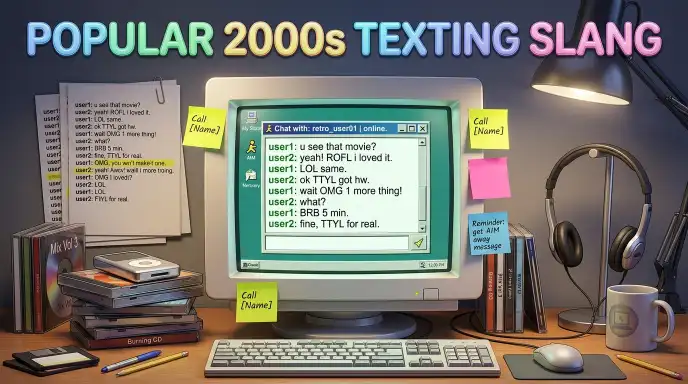
Texting was one of the biggest sources of Millennial slang during this period.
LOL
LOL means “laughing out loud.”
It became one of the most recognizable internet abbreviations of the era.
Example:
“That video was so funny LOL.”
Unlike many forgotten 2000s terms, LOL remains widely recognized today.
BRB
BRB means “be right back.”
People commonly used it in instant messaging when they temporarily stepped away from the computer.
“BRB, dinner’s ready.”
The phrase became closely associated with AIM, MSN Messenger, and early online chatting.
TTYL
TTYL means “talk to you later.”
It was commonly used at the end of an online or text conversation.
“I have to go. TTYL!”
OMG
OMG means “oh my God” or, depending on context, “oh my gosh.”
It was already known before the 2000s, but texting and online communication helped make it extremely familiar.
“OMG, you actually won!”
IDK
IDK means “I don’t know.”
It offered a quick way to answer a message without typing the complete phrase.
“IDK what time they’re coming.”
BFF and Other Friendship Slang
The 2000s also popularized several friendship related expressions.
BFF means “best friends forever.”
It became especially common in youth texting, social networking, captions, and profile descriptions.
“She’s my BFF.”
Another familiar expression was bestie, which is still used today.
People also used playful combinations such as:
- BFFL : best friends for life
- Bestie
- Best friends forever
- Girl bestie
- Ride or die
Not all of these originated in the 2000s, but many became highly visible during the period.
2000s Slang Like “Awesome,” “Sick,” and “Epic”
Some of the most recognizable Millennial slang was not created by the internet. Instead, older informal words became especially popular among young people during the 2000s.
Awesome
Awesome meant extremely good, impressive, or exciting.
“That movie was awesome.”
It remains common today.
Sick
In informal slang, sick could mean excellent, impressive, or exciting.
“Those shoes are sick.”
The meaning depended entirely on context. It did not mean the person was physically ill.
Epic
Epic described something unusually impressive, dramatic, or memorable.
“That concert was epic.”
The word became especially common in online communities and gaming.
Legit
Legit is short for legitimate and can mean genuine, impressive, trustworthy, or very good in casual speech.
“That new website is legit.”
These words are a good reminder that slang does not always mean a completely new word. A familiar word can develop a popular informal meaning.
2000s Internet Slang
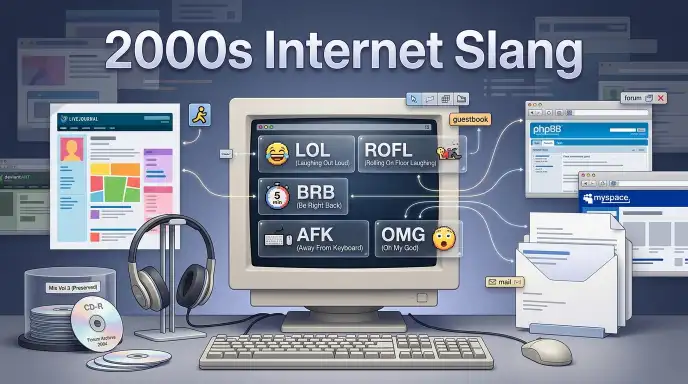
The early internet created its own vocabulary.
Noob
Noob refers to a beginner, especially someone inexperienced in an online game or community.
It is related to newbie, although the tone can be more teasing or insulting.
“He’s a noob at this game.”
The word remains common in gaming culture.
Troll
An online troll is someone who deliberately posts provocative or disruptive content to get reactions.
The word became increasingly associated with internet communities during the 2000s and remains widely used.
Pwned
Pwned is internet and gaming slang meaning someone was thoroughly defeated, embarrassed, or dominated.
“You just got pwned!”
The term became strongly associated with early gaming and internet culture.
Fail
Fail became popular as a noun or exclamation for an obvious mistake, embarrassing situation, or unsuccessful attempt.
“That was a total fail.”
Its later use became especially visible in internet humor and “fail” images and videos.
MySpace and 2000s Social Media Slang
MySpace played a major role in early social media culture.
People used informal language when writing:
- Profile bios
- Comments
- Friend messages
- Top 8 descriptions
- Photo captions
- Status style updates
Expressions such as OMG, BFF, LOL, hot, cute, awesome, and random appeared frequently in online profiles and conversations.
The style was often more decorative than modern texting. Users could customize profiles, add music, choose layouts, and write personal descriptions.
That environment helped turn slang into part of online identity.
2000s Pop Culture Slang
Music, television, movies, and celebrity culture also influenced Millennial slang.
Fo’ Shizzle
Fo’ shizzle is a playful expression associated with hip hop and early 2000s pop culture. It was used to mean something like “for sure.”
“Fo’ shizzle!”
The expression became widely recognizable through music and entertainment.
Bling
Bling referred to flashy or expensive looking jewelry and accessories.
“He was wearing serious bling.”
The term became strongly associated with hip hop culture and 2000s celebrity fashion.
Crunk
Crunk became associated with an energetic style of hip hop and party culture.
It could describe music, a party atmosphere, or someone being highly energized.
These terms had specific cultural roots, so they should not be treated as generic “Millennial words.”
2000s Slang From Gaming
Gaming culture contributed many expressions that later spread beyond gaming communities.
Noob described an inexperienced player.
Pwned described a decisive defeat.
GG means “good game” and is still widely used.
AFK means “away from keyboard.”
Respawn refers to returning to a game after a character has been eliminated.
These terms became familiar as online multiplayer gaming grew.
Some stayed inside gaming communities, while others entered general internet language.
2000s Slang vs. Gen Z Slang
Millennial slang and Gen Z slang overlap, but they developed during different internet eras.
| 2000s Millennial Era | More Recent Internet Culture |
| LOL | LMAO |
| BRB | AFK still used |
| BFF | Bestie |
| OMG | OMG still used |
| Noob | NPC |
| Epic | Slay |
| Sick | Fire |
| Legit | Valid |
| MySpace | TikTok |
| AIM | Discord |
This does not mean one generation stopped using its older slang completely. Many expressions continued across generations.
The bigger difference is the online environment that shaped the language.
Why Did 2000s Slang Become So Popular?
Technology changed how people communicated.
Before widespread social media, online conversations were often limited to instant messaging, chat rooms, forums, and early social networks.
Typing quickly mattered. Short abbreviations saved time.
At the same time, online communities created new social habits. People wanted quick ways to show humor, excitement, friendship, sarcasm, or emotion.
Pop culture added another layer.
Music, television, gaming, movies, and celebrity culture could turn a phrase into a mainstream expression almost overnight.
Is 2000s Millennial Slang Still Used?
Yes, but not every term has the same level of popularity.
Words such as LOL, OMG, BFF, IDK, legit, chill, and awesome remain recognizable and are still used in casual communication.
Other terms feel much more connected to the 2000s.
Expressions such as fo’ shizzle can sound deliberately nostalgic or humorous today.
This difference matters because “still understood” does not always mean “currently popular.”
Real Life Examples of 2000s Millennial Slang
Example 1 AIM style message
“BRB, my mom needs me. TTYL!”
The speaker is saying they will return soon and talk later.
Example 2 Excited reaction
“OMG! You got tickets? That’s epic!”
The message combines common 2000s expressions for surprise and excitement.
Example 3 Gaming
“Dude, you just got pwned.”
The speaker is teasing someone after a decisive defeat.
Example 4 Friendship
“She’s my BFF. We’ve known each other forever.”
Here, BFF means best friend forever.
Example 5 Describing something impressive
“Those new speakers are sick.”
Here, sick means impressive or very good.
Example 6 Online beginner
“Give him a chance. He’s still a noob.”
The speaker means the person is inexperienced.
Common Mistakes About 2000s Millennial Slang
One common mistake is assuming that every popular word from the 2000s was created by Millennials. Many expressions existed earlier and simply became more visible during that decade.
Another mistake is treating all 2000s slang as texting abbreviations. The era included spoken slang, gaming terms, music related expressions, internet language, and social media vocabulary.
It is also inaccurate to assume every Millennial used the same expressions. Age, location, friend groups, music preferences, gaming habits, and internet communities all influenced slang.
Finally, some terms had specific cultural origins. A slang word connected to hip hop, gaming, or another community should be understood within that context.
Key Takeaways
- Millennial slang from the 2000s developed alongside texting, instant messaging, gaming, and early social media.
- Common abbreviations included LOL, BRB, OMG, TTYL, IDK, and BFF.
- Words such as awesome, sick, epic, legit, and chill were widely used in casual speech.
- Gaming introduced terms such as noob, pwned, GG, and AFK.
- MySpace, AIM, MSN Messenger, music, television, and gaming all influenced 2000s language.
- Some 2000s slang remains common, while other expressions now mainly create a nostalgic or humorous effect.
FAQs About Millennial Slang 2000s
Q1. What slang was popular in the 2000s?
Popular 2000s slang included bling, chillin’, crunk, fo’ shizzle, homie, pimp, tight, sweet, legit, and my bad. Online culture also popularized terms such as LOL, OMG, BRB, and ROFL.
Q2. What are some millennial slangs?
Common millennial era slang includes bae, basic, salty, YOLO, lit, swag, epic, fail, sick, cool, and whatever. Some of these terms existed earlier but became especially common among millennials during the 2000s and 2010s.
Q3. What is 2000 to 2010 called in slang?
There is no single official slang name for 2000–2010. People commonly refer to it as the 2000s, the Noughties, or the early 21st century. “Noughties” is especially common in British and Australian English.
Q4. What was slang in 2007?
Some recognizable slang around 2007 included crunk, bling, pimp, sick, sweet, legit, chillin’, fo’ shizzle, and owned. Internet and texting slang such as LOL, OMG, TTYL, and BRB was also widespread.
Q5. What was slang in 2008?
Slang associated with 2008 included epic, fail, swag, sick, legit, chill, bromance, and noob. Social networking, gaming, texting, and early YouTube culture also helped spread terms like LOL, WTF, and FTW.
Q6. What was slang in 2006?
Popular slang around 2006 included bling, crunk, pimp, homie, fo’ shizzle, chillin’, tight, and owned. Gaming and internet communities also helped popularize terms such as noob and pwned.
Conclusion
Millennial slang from the 2000s reflects a major change in the way people communicated. Instant messaging, SMS texting, gaming, MySpace, forums, music, and early social networks all helped create a distinctive language style. Short forms such as LOL, BRB, OMG, TTYL, IDK, and BFF made online conversations faster, while words such as epic, sick, legit, and awesome became familiar parts of casual speech.
The 2000s also introduced internet specific language such as noob, troll, pwned, and fail. Some of these terms moved beyond their original communities and became part of wider online English.
Not every word from the decade was uniquely Millennial, and not every Millennial used the same slang. Still, the period played an important role in the development of modern digital communication. Many expressions from that era remain recognizable today, while others now bring a distinctly nostalgic 2000s feel.
Related Slang Terms:
Kangaroo Slang Meaning: Definition, Uses, and Examples
I am Emma Collins, a content writer at SlangAura specializing in internet slang, texting abbreviations, and online language. I create simple and accurate guides to help readers understand modern slang easily and confidently.