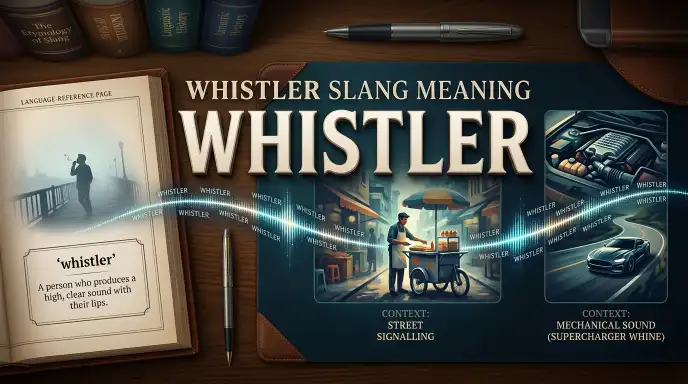
Whistler meaning slang can vary by context, but whistler most directly refers to a person who whistles. In informal English, it can describe someone known for whistling a tune, making a whistle sound, or using a whistle to get attention. The word can also appear in phrases with more specific meanings, so the surrounding conversation matters.
Quick Answer: Whistler usually means a person who whistles. In casual speech, it can describe someone who whistles often, whistles well, or uses a whistle to communicate or get attention. The word itself is not always slang; in many situations, it is simply an informal noun formed from the verb whistle.
Quick Answer: Whistler Meaning Slang
| Quick Detail | Meaning |
| Whistler meaning | A person who whistles |
| Base word | Whistle |
| Part of speech | Noun |
| Common use | Someone who whistles |
| Tone | Usually neutral or informal |
| Can be slang? | Sometimes, depending on context |
| Can describe a skill? | Yes |
| Can describe a habit? | Yes |
| Offensive by itself? | No |
| Formal English? | Yes, but context matters |
| Related word | Whistle |
The key point is that whistler is not automatically slang. Many people use it as an ordinary English noun. A slang meaning only becomes relevant when a particular community or context gives the word an additional meaning.
What Does Whistler Mean?
A whistler is a person who whistles.
The verb whistle can mean making a clear sound by blowing air through the lips. People whistle for many reasons. They may whistle a song, call someone, attract attention, or simply make the sound as a habit.
For example:
“My brother is a great whistler.”
This means the brother is good at producing or performing whistle sounds.
Another example:
“He’s always been a whistler.”
Here, the word describes a person who whistles frequently.
So, in its basic sense, whistler is simply someone who whistles.
Is Whistler Actually Slang?
Not necessarily.
This is an important distinction for anyone searching for whistler slang meaning.
The word whistler is a normal English noun. It follows a common word building pattern:
whistle + er = whistler
The er ending often creates a word for someone who performs an action.
For example:
- teach : teacher
- sing : singer
- run : runner
- whistle : whistler
Because of this, calling whistler slang in every situation would be inaccurate.
It may appear in informal or slang heavy conversations, but the word itself does not always have a special slang meaning.
Whistler as Someone Who Whistles
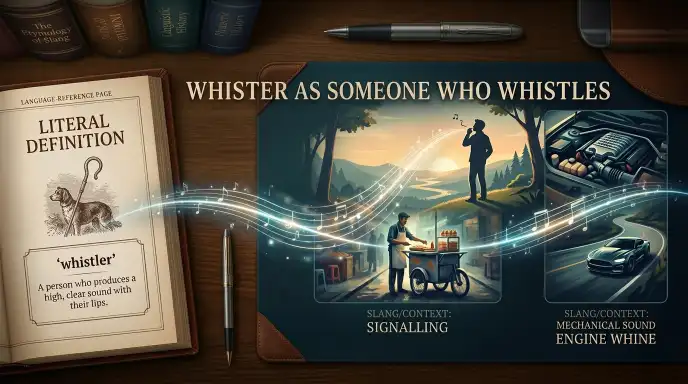
The most straightforward use describes a person’s habit.
For example:
“Jake is such a whistler. He whistles everywhere.”
Here, whistler tells us something about Jake’s behavior.
It does not suggest anything secret or coded.
The word can also describe someone who enjoys whistling music.
“She’s an amazing whistler.”
In this sentence, whistler refers to a skill.
The speaker is saying that she can whistle well.
Whistler Meaning in Casual Conversation
In everyday conversation, whistler can sound playful or descriptive.
Someone might jokingly call a friend a whistler because they keep whistling during the day.
For example:
“There goes the neighborhood whistler again.”
The speaker may simply be teasing someone who whistles often.
The tone can be:
- Friendly
- Playful
- Descriptive
- Teasing
The word itself is not offensive.
The speaker’s tone and the situation determine how it feels.
What Does “He’s a Whistler” Mean?
“He’s a whistler” usually means “he is someone who whistles.”
The sentence does not automatically carry a hidden meaning.
For example:
“Whenever he cooks, he’s a whistler.”
This means the person often whistles while cooking.
Another example:
“Tom is a talented whistler.”
This focuses on his ability to whistle.
The surrounding words help show if whistler describes a habit or a skill.
What Does “She’s a Good Whistler” Mean?
“She’s a good whistler” means she is skilled at whistling.
Someone may use this phrase when a person can whistle:
- Clearly
- Loudly
- In tune
- Different melodies
- With good control
For example:
“She can whistle the whole song. She’s a really good whistler.”
This is not a negative slang expression. It is simply a description of someone’s ability.
Whistler in Music
A whistler can also refer to someone who performs music by whistling.
Instead of singing lyrics, the person produces the melody with a whistle.
For example:
“The song features a professional whistler.”
In this context, whistler describes a performer.
This use is closer to standard English than slang.
It can appear in discussions about music, performance, recordings, and entertainment.
Whistler as a Person Who Uses a Whistle
A whistler can also mean someone who uses a whistle for a particular purpose.
For example, a person may use a whistle to:
- Signal others
- Get attention
- Direct a group
- Communicate over distance
- Start or stop an activity
The meaning depends on the situation.
For example:
“The referee was the only whistler on the field.”
Here, the word could describe someone who uses a whistle during a sporting activity.
The context gives whistler a more specific meaning.
Whistler in Sports
Sports can give the word whistler a practical meaning.
Referees and officials often use whistles to control play.
For example:
“The whistler stopped the game.”
In this sentence, whistler may refer informally to the referee or official who uses the whistle.
This type of usage is context specific. It does not mean that whistler always means referee.
That distinction is important when interpreting slang or informal language.
Whistler and “Whistleblower” Are Different
A common mistake is confusing whistler with whistleblower.
They are not the same word.
A whistler is generally someone who whistles.
A whistleblower is a person who reports wrongdoing, illegal activity, or other serious misconduct, often within an organization.
For example:
“He is a talented whistler.”
This relates to making a whistle sound.
But:
“She became a whistleblower.”
This refers to reporting serious problems or misconduct.
The two words share whistle, but their meanings are very different.
Whistler vs. Whistleblower
| Word | Basic Meaning |
| Whistler | Someone who whistles |
| Whistleblower | Someone who exposes or reports wrongdoing |
| Whistle | A sound or the act of making that sound |
This difference matters because someone searching for whistler slang may actually have encountered whistleblower in a completely different context.
Can Whistler Be a Nickname?
Yes, whistler can be used informally as a nickname.
If someone constantly whistles, friends might jokingly call them:
“The Whistler”
For example:
“Everyone calls Marcus the Whistler because he never stops whistling.”
Here, Whistler works as a playful nickname based on the person’s habit.
It does not create a new dictionary meaning. It simply gives the person a memorable label.
Whistler as a Playful Insult
In some situations, whistler can be used teasingly.
Imagine someone repeatedly whistles while other people are trying to concentrate.
A friend might say:
“Okay, Whistler, give us a minute!”
This is more playful than insulting.
The meaning comes from the situation rather than from a fixed slang definition.
If the speaker uses an annoyed tone, the same word can sound less friendly.
Does Whistler Have a Negative Meaning?
Whistler does not have a negative meaning by itself.
It becomes negative only when the surrounding context makes it negative.
For example:
“He’s a talented whistler.”
This is positive.
“That annoying whistler is back.”
This is negative because the speaker dislikes the person’s constant whistling.
The word itself remains the same. The tone changes its effect.
Whistler in Texting
You may see whistler in casual messages when someone is talking about a person who whistles.
For example:
“Your little brother is such a whistler 😂”
This could be a playful comment about someone’s habit.
Another message might say:
“Who’s that whistler in the background?”
Here, the person is asking about someone making a whistling sound.
Unlike highly compressed texting slang, whistler usually does not need special decoding.
Real Life Examples of Whistler
Example 1: A Habit
Nina: “Why is your dad always whistling?”
Omar: “He’s been a whistler forever.”
Here, whistler describes a long term habit.
Example 2: A Skill
Ava: “Can she really whistle that melody?”
Mia: “Yeah, she’s an incredible whistler.”
Here, the word describes musical ability.
Example 3: Friendly Teasing
Leo: “You’ve been whistling for ten minutes.”
Ryan: “What can I say? I’m a whistler.”
Here, the word is used humorously.
Example 4: Sports
Sam: “Who stopped the match?”
Chris: “The whistler called it.”
Here, whistler is an informal reference to the official using the whistle.
Example 5: Background Noise
Ella: “Who’s the whistler behind you?”
Grace: “My cousin. He does that all the time.”
Here, whistler identifies someone by the sound they are making.
Common Mistakes With Whistler
Mistake 1: Assuming Whistler Is Always Slang
Whistler is often just a normal English noun meaning someone who whistles.
Mistake 2: Confusing Whistler With Whistleblower
These words have different meanings. A whistleblower reports wrongdoing, while a whistler generally whistles.
Mistake 3: Assuming Whistler Is Offensive
The word itself is neutral. The tone of the sentence determines how it sounds.
Mistake 4: Thinking It Always Means a Musician
A whistler can simply be someone who whistles as a habit.
Mistake 5: Giving It One Fixed Slang Meaning
Context matters. The word can describe a habit, skill, performer, nickname, or person using a whistle.
Whistler in Different Contexts
The meaning of whistler can shift slightly depending on the setting.
In everyday conversation, it usually means someone who whistles.In music, it can describe someone who performs by whistling.
The word becomes more specific when the conversation gives it a clear role.
| Context | Possible Meaning of Whistler |
| Everyday conversation | Someone who whistles |
| Music | A person who performs by whistling |
| Sports | An official who uses a whistle |
| Friendly teasing | Someone who whistles often |
| Nickname | A person known for whistling |
| Sound description | Someone making a noticeable whistle |
This is why context matters more than treating whistler as one fixed slang term.
Whistler vs. Whistle
Whistle and whistler are closely related, but they have different grammatical roles.
Whistle can be a noun or verb.
“I heard a whistle.”
“He can whistle.”
Whistler is a noun for the person doing the action.
“He is a talented whistler.”
The er ending often identifies the person who performs an action.
That pattern also appears in words such as runner, singer, and dancer.
Whistler vs. Whistling
These words should not be confused.
Whistling describes the action or sound.
Whistler describes the person.
For example:
“The whistling was loud.”
This focuses on the sound.
“The whistler was sitting outside.”
This focuses on the person making the sound.
This small difference can help you understand the word quickly in a sentence.
Can Whistler Describe a Person Who Flirts?
The word whistler itself does not automatically mean a flirt.
A person may whistle at someone in a way that is intended as flirting, teasing, or attention seeking. However, calling that person a whistler simply identifies the person who whistles.
The meaning should not be expanded into a fixed slang definition without context.
For example:
“He whistled when she walked past.”
This describes an action.
It does not automatically mean:
“He is a whistler” = “He is a flirt.”
Those are different ideas.
Whistler and Catcalling
A whistle can sometimes be part of catcalling, especially when someone whistles at a stranger in a sexual or unwanted way.
In that situation, the behavior may be described as catcalling, while whistler simply describes the person making the whistle.
For example:
“The man was whistling at people on the street.”
The word whistler alone does not explain the intention.
The surrounding behavior and situation provide that information.
This distinction prevents the slang meaning from becoming broader than the evidence supports.
Is Calling Someone a Whistler Rude?
Usually, no.
Calling someone a whistler is normally neutral or playful.
For example:
“My sister is a morning whistler.”
That sounds harmless.
However, the word can become negative when the speaker is annoyed.
“That whistler is driving everyone wild.”
Here, the criticism is about the person’s behavior, not the word itself.
Tone, situation, and the speaker’s relationship with the person all matter.
Whistler in Pop Culture and Writing
Whistler can work as a descriptive word in stories, movies, songs, and casual dialogue.
A writer might introduce a character as someone who constantly whistles.
For example:
“The old whistler walked down the street.”
This creates a quick image of a person known for making a whistle sound.
The word can also help create a character trait without explaining it in several sentences.
Is Whistler Common in Everyday English?
Whistler is understandable in everyday English, but people do not always use it.
Many speakers simply say:
- “He whistles a lot.”
- “She can whistle really well.”
- “He’s always whistling.”
Instead of:
“He’s a whistler.”
So, whistler is a valid word, but its frequency depends on the speaker and context.
This is one reason it can sometimes feel more descriptive or playful than ordinary.
Whistler in British and American English
The basic meaning of whistler is understandable in both British and American English.
There is no need to assume a completely different meaning based only on the speaker’s country.
Regional differences may appear in the situation or expression surrounding the word, but whistler itself generally retains its connection to whistling.
Online communication also makes regional vocabulary easier to encounter across different English speaking communities.
Whistler as a Descriptive Label
Sometimes people create informal labels from a person’s most noticeable habit.
Someone who whistles frequently might become:
“the whistler”
This can happen among friends, coworkers, classmates, or family members.
The label may be temporary.
For example:
“We couldn’t find the guy’s name, so everyone called him the whistler.”
This use is more about identification than slang.
Common Phrases Related to Whistler
There are several expressions involving whistle that can appear alongside the word whistler.
Whistle a Tune
This means to produce a melody by whistling.
“She was whistling a tune.”
Whistle for Attention
This means using a whistle sound to get someone’s attention.
“He whistled for his friend.”
Blow the Whistle
This can mean using a whistle literally, but it can also have a figurative meaning connected with reporting wrongdoing.
That figurative expression is different from simply calling someone a whistler.
Whistler and “Blow the Whistle”
This distinction is especially useful.
“Blow the whistle” can have a figurative meaning related to exposing or reporting wrongdoing.
Whistler does not automatically carry that meaning.
For example:
“The referee blew the whistle.”
This is literal.
But:
“The employee blew the whistle on the company.”
This is figurative.
Calling the employee a whistler would not normally express the same idea.
Real Life Examples of Whistler Slang
Example 1: The Office Whistler
Daniel: “Who keeps whistling near my desk?”
Mark: “Probably Jason. Everyone knows he’s the office whistler.”
Here, whistler is a playful label based on a habit.
Example 2: A Music Performer
Sara: “Who performed that melody?”
Lily: “A professional whistler.”
Here, the word describes a person using whistling as a performance skill.
Example 3: Friendly Complaint
Adam: “Can you stop whistling for a second?”
Ben: “Sorry. I’m just a natural whistler.”
Here, the word is used casually and humorously.
Example 4: Sports
Ryan: “Why did everyone stop playing?”
Chris: “The whistler called a foul.”
Here, whistler refers informally to the official using a whistle.
Example 5: Identifying Someone
Maya: “Which person was making that sound?”
Emma: “The whistler near the door.”
Here, the word identifies the person by their noticeable action.
Frequently Asked Questions About Whistler
Q1. What does “whistler” mean?
A whistler is a person who whistles, usually by making a clear sound with their lips. It can also describe something that produces a whistling sound.
Q2. What is a synonym for “whistler”?
Depending on the context, synonyms include whistling person, whistling bird, caller, or tweeter. The best synonym depends on if you mean a person, sound, or object.
Q3. What does “whistle” mean in urban slang?
In slang, “whistle” can have different meanings depending on the community and context. It may refer to calling someone’s attention, making a signal, or, in some contexts, a coded or suggestive reference.
Q4. What does the name “Whistler” mean?
The name Whistler is generally an English occupational or descriptive surname connected with someone who whistles. It comes from the word “whistle” with the er ending, meaning a person who performs the action.
Q5. What is a “Whistler” in slang?
“Whistler” does not have one universal slang meaning. In casual speech, it can simply describe someone who whistles, while particular communities may use it differently.
Q6. Why is Whistler named Whistler?
If you mean Whistler, British Columbia, the name is associated with the whistling sound of the local hoary marmots. The area was historically called London Mountain before the name Whistler became established.
Key Takeaways
- Whistler generally means a person who whistles.
- The word is not automatically slang.
- It can describe a habit, talent, performance, or whistle based role.
- In sports, it may informally refer to an official who uses a whistle.
- Whistler is different from whistleblower.
- The word itself is not offensive.
- Tone can make the word playful, neutral, or negative.
- Context is important when interpreting unusual uses of whistler.
Conclusion
The whistler meaning slang question does not have one hidden definition. In most situations, whistler simply means a person who whistles. It can describe someone who whistles often, someone who is skilled at whistling, or a performer who uses whistling as part of their work.
In casual speech, friends may also use whistler as a playful nickname for someone known for the habit. Sports can give the word a more specific informal use when referring to an official who uses a whistle. At the same time, whistler should not be confused with whistleblower, which has a separate figurative meaning.
The safest way to understand whistler is to look at the complete sentence. The surrounding words usually show if it describes a person’s habit, skill, role, or nickname.
Next Up!
Addy Slang Meaning: Definition, Uses, and Texting Examples

I am Masson Caldwell, a language enthusiast and content writer at SlangAura. I write about internet slang, texting trends, and modern expressions to help readers understand the evolving world of online language with simple and clear explanations.