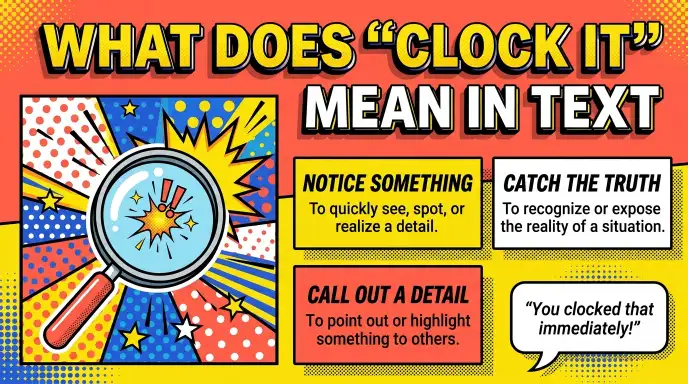
Clock it means you caught the hidden truth. When someone says “clock it,” they mean “you noticed exactly what was going on.”
You see it all over TikTok comments, Instagram captions, and group chats. “Clock it!” shows up under a video where someone spotted a tiny detail everyone else missed.
People search this phrase because it sounds simple but carries deep history. It is not new slang from last week. It comes from ballroom culture, and it has a story worth knowing.
This guide covers the real meaning, how to say it, where people use it, ten real chat examples, smart replies, the finger tap gesture, the origin story, reading vs clocking, and a comparison with similar slang. By the end, “clock it” will make complete sense.
Short Answer
In texting, clock it = “you caught that”. It means to notice, recognize, or call out a hidden truth. It comes from AAVE and Black and Latinx ballroom culture, and it is friendly, never rude.
Clock It Meaning in Text
Clock it is slang, but it is not an acronym. It has no full form. It is a regular English verb, “clock,” wearing a new meaning online.
To clock something means to notice it, recognize it, or call it out. When someone says “clock it,” they are saying “pay attention to this” or “did you catch that?” It often exposes a real motive or highlights a small inconsistency.
The phrase has four uses you should know. First, “you caught that”: someone noticed a hidden detail. Second, approval: “clock it!” cheers someone who called out the truth. Third, “clock that tea”: validating someone who spilled gossip. Fourth, being clocked: in ballroom and trans communities, being recognized as trans, often against your wishes, which carries real safety risks.
In everyday texting, the first two uses dominate. It is a sharp, sassy way to say “exactly right.”
How to Say It and Use It
Say it as KLOK it. The verb forms are simple: clock, clocked, clocking. “I clocked it.” “She is clocking everything today.”
It works two ways. As a reply, it backs up what someone else spotted. As an order, it tells people where to look: “clock the way she said that.”
One warning: younger users sometimes say it as a general compliment when nothing is hidden. Ballroom speakers call that a drift from the real meaning.
Where People Use Clock It
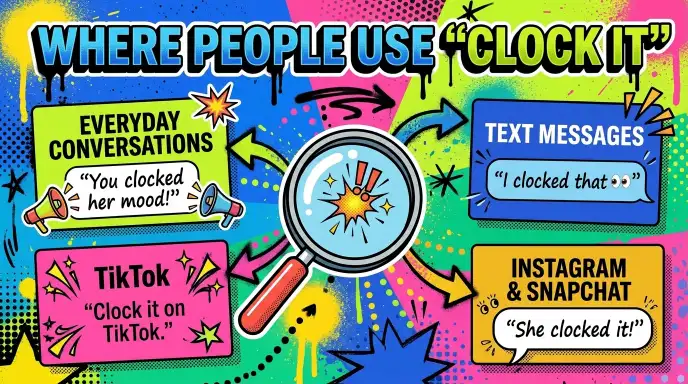
TikTok
TikTok made clock it explode. The phrase was first popularized on TikTok by user @queenopplive, and a widely reused audio spread it in 2023.
The most common format is the Stitch: one user posts something shady, another stitches it, pauses, taps their fingers, says “Clock it,” and explains why the first user is wrong.
In April 2025, a Love Island USA contestant’s freestyle rap tied it to the finger tap, and the trend went massive. Comments now say “clock it!” under any sharp observation.
Snapchat
On Snapchat, friends drop “clock it” in quick chats when someone spots the truth. “Clock it, she was lying” lands in a snap reply. It fits the fast, punchy style of the app.
Instagram comments and reels use it constantly. “Clock it!!” under a celebrity’s shady post. Creators caption their videos with it when they expose a detail. It works as both praise and a callout.
WhatsApp groups use clock it for group chat detective work. Someone spots a contradiction in a story, and the group replies “clock it.” It turns noticing into a shared joke.
SMS
In plain texting, clock it is short and punchy. “Clock it, he read the message and didn’t reply.” No explanation needed between friends who know the phrase.
Real Chat Examples
1.
A: Did you see her post? She was totally at that party
B: Clock it!! I knew it
A: She tried to hide it so bad lol
2.
A: He said he was busy but he’s online rn
B: Clock it
A: Caught in 4K honestly
3.
A: Clock it, the teacher knew we copied
B: She was smiling the whole time 😭
A: We were SO obvious
4.
A: Wait, did you clock what she just said?
B: Yesss, the shade was real
A: She didn’t even try to hide it
5.
A: Clock it! You read him perfectly
B: Thank you, I stay observant
A: Detective energy fr
6.
A: I clocked that side eye she gave him
B: SAME. It was so loud
A: The tension was unreal
7.
A: Clock that tea sis, spill it all
B: Okay so listen…
A: I’m ready 👀
8.
A: Did anyone else clock the ring on her finger?
B: CLOCK IT, I saw it first!
A: Wedding bells loading…
9.
A: Bro clock it, he’s wearing the same shoes as you
B: Twin behavior honestly
A: Great minds dress alike lol
10.
A: Clock it, the plot twist was obvious
B: I called it in episode one
A: You really did, respect
How to Reply When Someone Says “Clock It”
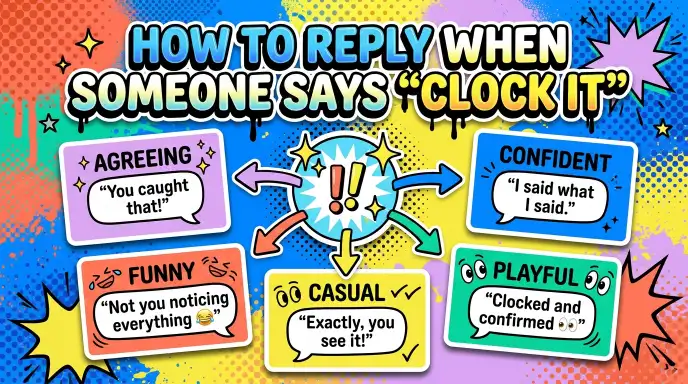
Funny Replies
- “Clocked and locked, detective 🕵️”
- “I see everything, nothing gets past me 😎”
- “My clock is always ticking lol”
Casual Replies
- “Fr, I clocked it too”
- “Yeah I saw that”
- “Clock it, exactly”
Friendly Replies
- “You always notice everything! 🫶”
- “Good catch, I missed that one”
- “Clock it bestie, you never miss”
Neutral Replies
- “True”
- “Yeah, I noticed”
- “Fair point”
Is Clock It Rude or Offensive?
No, clock it is not rude or offensive in everyday use. It is playful approval, like saying “good catch.” It is safe on every major app and breaks no rules.
At school or work, it is fine between friends. You would not say it to your boss in a formal meeting, but that is about professionalism, not rudeness.
One important note: the older ballroom meaning of “being clocked” is serious. In trans and ballroom communities, being clocked means being recognized as trans against your wishes, which carried real safety risks. Respect that history. In casual texting, nobody uses it that way, but knowing the weight behind the word matters.
Other Meanings of Clock
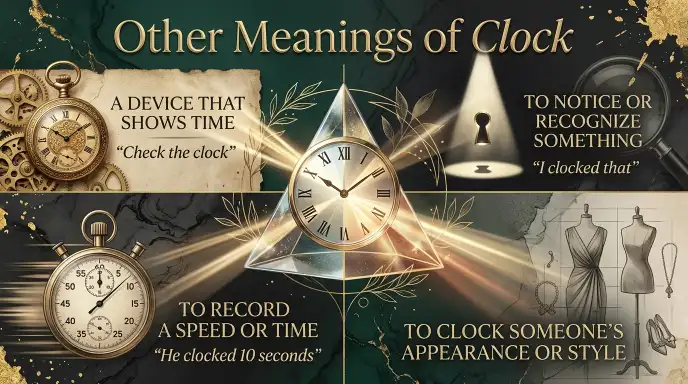
The word “clock” has literal meanings too. To clock someone can mean to hit them, as in “he clocked him in the face.” Workers clock in and out at their jobs. Neither is the slang, but both share the same verb.
In everyday slang, “to get clocked” also means to be caught out. “He got clocked cheating on the test.” Same verb, very different weight, so context always decides.
Who Uses This Term?
Gen Z uses clock it the most. Teens and twenty somethings say it daily in comments and chats. Gen Alpha picked it up too, especially after the Love Island moment.
The roots run through AAVE and Black and Latinx LGBTQ+ ballroom culture in New York City. The scene grew from the 1960s through the 1980s, built by Black and Latinx queer and trans people. Drag culture and RuPaul’s Drag Race carried the phrase to wider audiences.
It lives on TikTok, Instagram, Snapchat, X, and Discord. By 2026, even mainstream outlets were explaining it. Indian MP Bansuri Swaraj even used it in Parliament, which shows how far the phrase has traveled.
Origin of the Term
The verb “clock” is far older than TikTok. Slang dictionaries record “clock,” meaning to see, notice, or unmask, from at least 1911. By 1972, it was San Francisco gay slang for sizing someone up. The exclamation “clock it!” is labeled as US Black and gay usage for approval.
Ballroom made it its own. The scene was built by Black and Latinx queer and trans people in New York in the mid to late twentieth century.
In ballroom, clocking meant spotting what someone tried to conceal, including if a person passed in the “Realness” categories. To pass meant to be unclockable: so perfect that nobody could question your authenticity, often a matter of safety, not just performance. The exact origin of the phrase “clock it” is unclear, and no source dates its first use.
Drag and reality TV carried it wider. RuPaul’s Drag Race contestants clock each other’s outfits, attitudes, and strategies. TikTok revived it in 2023 through a reused audio, and the Love Island rap in April 2025 pushed it fully mainstream.
The finger tap is a separate story. The gesture, thumb tapping the middle finger, is really the ballroom finger clap, a silent way to applaud or validate a performer. The internet merged it with “clock it,” but ballroom voices point out they are two different things. Clocking means recognizing a hidden truth.
The finger clap means approval. Now you know the difference, and almost nobody online does. One more honest note: some sites describe a “tap your wrist like a watch” version of the gesture, but no ballroom or journalistic source confirms it, so treat that one as unconfirmed.
Reading vs Clocking
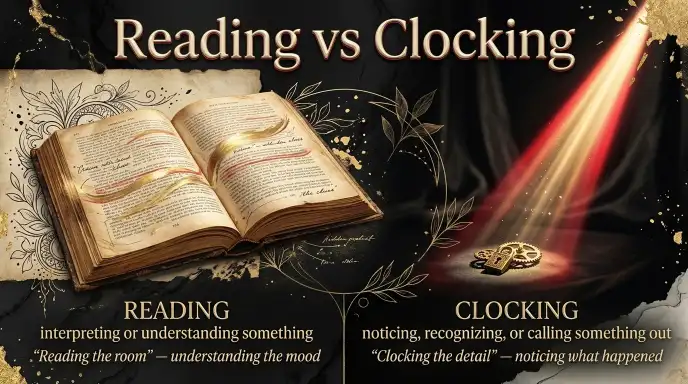
People mix up reading and clocking, but they are different. As Dorian Corey said in the documentary Paris Is Burning, “Reading is fundamental.” Reading is the art of witty, creative insults: finding a flaw and exaggerating it for laughs.
Clocking is about facts, not wit. You do not need to be funny to clock someone, only observant. A read entertains. A clock exposes.
The AAVE to Mainstream Pipeline
Clock it followed a path many slang words take. It moved from Black queer ballroom spaces to RuPaul’s Drag Race, then to Stan Twitter, and finally to the mass market of TikTok and Instagram Reels. The same pipeline carried “spill the tea,” “shade,” and “slay” before it.
As it traveled, its stakes lowered. It moved from “I clocked her Adam’s apple” (a safety context) to “I clocked that side eye” (a hidden emotion) to today’s simple “Clock it.” The word softened, but its roots stayed the same.
Clock It vs Similar Slang
| Term | Meaning | Type | Usage | Vibe |
| Clock It | You caught the hidden truth | Slang phrase | Callouts, approval | Sharp, sassy |
| Clock That Tea | Validating spilled gossip | Slang phrase | Gossip, drama | Playful, hype |
| Spill the Tea | Share the gossip | Slang phrase | Gossip, secrets | Juicy, dramatic |
| Read | Call someone out cleverly | Slang verb | Drag, shade | Witty, cutting |
| Shade | Subtle disrespect | Slang noun | Insults, drama | Cool, shady |
Clock it stands out by stressing noticing. Spill the tea is about sharing. A read is about wit. Clock it says “I saw what you tried to hide.”
Real World Usage Example
Picture this. Your favorite creator posts a “get ready with me” video. In the background, on the nightstand, sits a ring box. Nobody mentions it. The comments explode.
“Clock it, the ring box??” gets thousands of likes. “CLOCK IT, I saw it first!” replies another fan. The creator laughs in the next video and says, “Y’all clock everything.”
That is the slang in real life. One sharp observation, one phrase, and thousands of strangers share the same “aha” moment. Clock it turns noticing into a community sport.
Here is another one. A friend posts two coffee cups and a hand that clearly is not hers, captioned “sunday.” The comments say “clock it,” because everyone sees the soft launch. The phrase names the moment a hidden thing gets seen.
Frequently Asked Questions
1. What does clock it mean in text?
Clock it means “you caught that.” In texts, it means to notice, recognize, or call out a hidden truth. When someone says “clock it,” they are praising a sharp observation or pointing at a detail others missed. It is friendly approval, never an insult.
2. What does clock it mean on TikTok?
On TikTok, clock it means to spot the hidden truth in a video or comment. It exploded through a 2023 audio trend and the 2025 Love Island finger tap moment. Comments say “clock it!” under sharp observations, and creators use it to validate fans who notice details.
3. Is clock it slang?
Yes, clock it is slang. It comes from AAVE and Black and Latinx ballroom culture. The verb “clock,” meaning to notice or unmask, appears in slang dictionaries from at least 1911. TikTok and drag culture carried it to mainstream Gen Z use.
4. What is the finger tap gesture?
The finger tap, thumb tapping the middle finger, is often shown with “clock it” on TikTok. In ballroom, it is actually a finger clap, a silent way to applaud a performer. The internet merged the gesture with the phrase, but they are two different things.
5. Is clock it rude or offensive?
No, clock it is friendly and never rude in everyday use. It means approval, like “good catch.” One note: the older ballroom meaning of “being clocked” is serious and tied to safety for trans people. Respect that history even when using the casual version.
6. What is the difference between clock it and clock that tea?
Clock it means noticing a hidden truth. Clock that tea specifically validates someone spilling gossip. Tea is gossip. So “clock that tea” means “yes, that gossip is real, keep going.” Clock it works in any situation, not just gossip.
7. How should you reply to clock it?
Match the energy. “Fr, I clocked it too” always works. Add humor with “clocked and locked, detective.” In comments, a simple “CLOCK IT!!” is perfect. The phrase invites agreement, so reply like you saw it too.
8. Where did clock it come from?
The commonly given origin is Black and Latinx LGBTQ+ ballroom culture in New York City, with the verb “clock” recorded from 1911. RuPaul’s Drag Race carried it wider, and TikTok revived it in 2023. The exact first use of the phrase is unconfirmed, so treat the origin as the reported story.
9. Is clock it a compliment or an insult?
Neither by default. It simply says something was noticed. Backing up a friend’s sharp call out, it is praise. Pointed at someone’s lie or shade, it is a call out. The target decides the tone, not the phrase.
Conclusion
Clock it means you caught the hidden truth. In texts, it is sharp praise for a good eye, a nod to ballroom history, and a TikTok staple all in one. It grew from a 1911 verb through New York ballroom and drag culture into everyday Gen Z language.
Use it when someone spots what others missed. And remember the finger tap is really a finger clap.
🦋 Word Voyage:
What Does Twin Mean in Text? Real Meaning & Examples
I am Emma Collins, a content writer at SlangAura specializing in internet slang, texting abbreviations, and online language. I create simple and accurate guides to help readers understand modern slang easily and confidently.