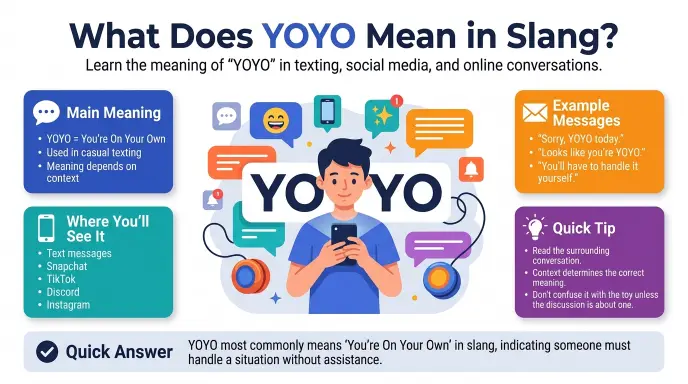
YOYO slang can have different meanings depending on the context. In modern texting and online conversations, YOYO most commonly stands for “You’re On Your Own,” meaning someone must handle a situation without help.
In some conversations, “yo yo” can also describe a person who frequently changes their mind or behaves unpredictably. Because YOYO has more than one meaning, many people search for its slang definition to understand messages correctly. Looking at the surrounding conversation is the best way to identify the intended meaning.
Quick Answer:Yoyo Slang
In slang, YOYO most commonly means “You’re On Your Own.” It tells someone they need to deal with a situation without assistance, although yo-yo can also describe someone who is inconsistent or keeps changing their decisions.
What Does YOYO Mean in Text?
In text messages and online chats, YOYO usually means “You’re On Your Own.” People use it when someone must solve a problem or complete a task without help.
For example:
“Sorry, I can’t come. YOYO.”
This means the other person will have to manage on their own.
YOYO as “You’re On Your Own”
This is the most common abbreviation meaning.
People use YOYO when:
- They cannot help someone.
- Someone must make their own decision.
- A person needs to handle a situation independently.
Examples:
- “The teacher changed the assignment. YOYO now.”
- “I’m leaving early, so YOYO.”
- “Good luck! YOYO.”
The phrase is usually straightforward rather than rude.
Yo-Yo as a Description
Sometimes yo-yo is not an abbreviation at all.
Instead, it describes someone who:
- Frequently changes their opinion.
- Cannot make consistent decisions.
- Acts unpredictably.
Example:
- “Stop being such a yo-yo and make a decision.”
This meaning is less common in texting but still appears in everyday English.
Full Form of YOYO
The most common full form of YOYO in slang is:
YOYO = You’re On Your Own
People mainly use this abbreviation in casual conversations and text messages.
YOYO in Texting
When friends text YOYO, they usually mean the other person must handle something without assistance.
Example:
- “I can’t cover your shift. YOYO.”
YOYO in Online Chats
In group chats or gaming communities, YOYO can mean teammates must continue without someone’s help.
Example:
- “My internet is down. YOYO for this round.”
Always read the surrounding conversation to understand if YOYO is being used as an abbreviation or simply as the word yo-yo.
Different Meanings of YOYO
Although You’re On Your Own is the most common slang meaning, YOYO can have different meanings depending on the situation.
You’re On Your Own
This is the primary internet slang definition.
Example:
- “Sorry, YOYO today.”
Someone Who Changes Their Mind
The word yo-yo can describe a person who constantly changes opinions or decisions.
Example:
- “He’s being a yo yo about his plans.”
Sports and Fitness
In some fitness discussions, yo-yo refers to repeated weight gain and weight loss, often called yo-yo dieting.
Example:
- “Doctors recommend avoiding yo-yo dieting.”
This is a standard English expression rather than internet slang.
Is YOYO Rude, Offensive, or Neutral?
YOYO is generally neutral, but the tone depends on how it is used.
Friendly Use
Friends sometimes use YOYO jokingly.
Examples:
- “I’m busy today. YOYO 😂”
- “Good luck you’ve got this. YOYO!”
Neutral Use
People may use YOYO simply to explain they cannot help.
Examples:
- “I have another meeting. YOYO.”
- “You’ll need to finish the project yourself.”
Can YOYO Be Offensive?
No.
The abbreviation itself is not offensive. However, telling someone “You’re On Your Own” during a difficult situation may sound unsympathetic if the tone is unfriendly. Using polite wording can make the message sound more considerate.
Where Is YOYO Commonly Used?
YOYO is mainly used in casual conversations, text messages, and online chats. Although it is less common than abbreviations like LOL or BRB, many people still recognize it in the right context.
Text Messages
In texting, YOYO usually means “You’re On Your Own.” It lets someone know they must handle a situation without help.
Examples:
- “Sorry, I can’t make it. YOYO.”
- “I’m offline now. YOYO until I get back.”
Social Media
On platforms like TikTok, Instagram, Facebook, Reddit, and X, YOYO may appear in comments or captions when someone jokingly says another person has to manage on their own.
Examples:
- “Missed the sale? YOYO 😂”
- “I’m done explaining. YOYO.”
Gaming Communities
Gamers sometimes use YOYO when a teammate disconnects or cannot continue playing.
Examples:
- “My game crashed. YOYO this round.”
- “I’ll be AFK for a few minutes. YOYO.”
Everyday Conversations
Outside the internet, the word yo-yo is also used to describe someone who frequently changes their opinions or decisions.
Example:
- “Stop acting like a yo-yo and choose one option.”
Real-Life Examples of YOYO Slang
The following examples show how YOYO is used in different situations.
Friendly Conversation
- “I have to leave early. YOYO!”
- “You’ll do great. YOYO this time.”
- “Sorry, I can’t help today. YOYO.”
Casual Text Messages
- “The project is due tonight. YOYO.”
- “I’m busy after work. YOYO until tomorrow.”
- “You’ll have to figure it out. YOYO.”
Gaming
- “My internet disconnected. YOYO!”
- “I’m spectating now. YOYO this match.”
- “Good luck, team. YOYO!”
Social Media
- “Forgot your password? YOYO 😂”
- “No spoilers from me. YOYO.”
- “I already finished mine. YOYO!”
These examples show that YOYO is usually used in casual situations where someone must continue without help.
Origin and Background of YOYO Slang
The abbreviation YOYO developed from the phrase “You’re On Your Own,” which has been used in spoken English for many years.
As texting and online messaging became more popular, people shortened longer phrases into abbreviations to type faster. YOYO became one of these informal shortcuts, although it never reached the popularity of abbreviations like LOL, BRB, or OMG.
The word yo-yo itself has existed much longer and has also been used figuratively to describe someone who is inconsistent or constantly changes direction.
Today, both meanings can appear in conversations, making context important.
Comparison with Similar Slang
Several abbreviations have meanings related to YOYO, but each is used differently.
| Slang | Meaning | Similar to YOYO? |
| YOYO | You’re On Your Own | Base term |
| DIY | Do It Yourself | Similar |
| BRB | Be Right Back | No |
| IMO | In My Opinion | No |
| AFK | Away From Keyboard | No |
| Solo | Alone or independently | Similar |
Although DIY and solo also suggest doing something independently, YOYO specifically tells someone they must manage without another person’s help.
When Should You Avoid Using YOYO?
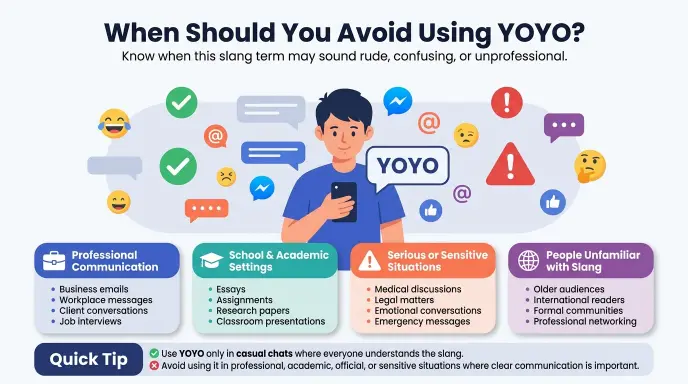
Although YOYO is harmless, there are situations where using the full phrase is clearer and more polite.
Professional Communication
Avoid using YOYO in:
- Business emails
- Official documents
- Academic writing
- Workplace presentations
Writing “You’re on your own” or another clear explanation is usually more professional.
Serious Conversations
If someone is dealing with a difficult problem or asking for support, YOYO may sound cold or dismissive.
In these situations, a more supportive response is often better.
Speaking with People Unfamiliar with Slang
Many people have never seen YOYO used as an abbreviation.
Writing the full phrase helps avoid confusion.
Polite Alternatives to YOYO
If you want to sound more helpful or professional, these alternatives work well.
Instead of YOYO
Use:
- You’ll need to handle this yourself.
- You’re on your own.
- You’ll have to manage without me.
- I can’t help this time.
- Best of luck.
These alternatives are clearer and often sound more considerate, especially in formal or sensitive situations.
Why Do People Use YOYO?
People use YOYO because it is a short and convenient way to say “You’re On Your Own.” It helps save time while typing and clearly tells someone they need to handle a situation without assistance.
Common reasons people use YOYO include:
- To send quick text messages.
- To explain they cannot help.
- To respond during gaming sessions.
- To keep online conversations brief.
- To communicate casually with friends.
Since YOYO is less common than abbreviations like LOL or OMG, some people may not immediately recognize its meaning.
Impact of Using Slang in Communication
Using abbreviations like YOYO makes digital conversations quicker and more informal. However, understanding your audience is important because not everyone is familiar with this slang.
Advantages
- Saves time while typing.
- Makes casual conversations faster.
- Easy to use in texting and gaming.
- Helps keep messages short.
- Useful among people who understand internet slang.
Disadvantages
- Many people do not recognize YOYO.
- It can be misunderstood without context.
- Not suitable for formal communication.
- May sound unsympathetic in serious situations.
Choosing the right situation ensures your message is understood correctly.
Is YOYO Safe for Social Media?
Yes. YOYO is generally safe to use on social media.
It may appear on TikTok, Instagram, Facebook, Reddit, Discord, X, and messaging apps when someone wants to say another person must handle something independently.
Before using YOYO, remember these tips:
- Use it in casual conversations.
- Avoid using it when someone needs emotional support.
- Consider if your audience understands the abbreviation.
Overall, YOYO is a harmless slang term when used respectfully and in the right context.
Frequently Asked Questions
Q1. What does YOYO mean in slang?
In slang, YOYO most commonly stands for “You’re On Your Own.” It means someone must deal with a situation without help.
Q2. What is the full form of YOYO?
The full form of YOYO is “You’re On Your Own.”
Q3. Is YOYO used in texting?
Yes. People use YOYO in text messages to say that someone needs to manage a task or problem by themselves.
Q4. Is YOYO rude?
No. YOYO is not rude by itself, but it may sound blunt depending on the tone and situation.
Q5. Where is YOYO commonly used?
You may see YOYO in text messages, gaming chats, Discord servers, Reddit discussions, and casual social media conversations.
Q6. Does YOYO have more than one meaning?
Yes. YOYO usually means “You’re On Your Own,” but yo-yo can also describe someone who frequently changes their mind or behaves inconsistently.
Q7. Is YOYO appropriate at work?
It is best to avoid YOYO in professional emails or formal documents because many people may not recognize the abbreviation.
Q8. Is YOYO still popular?
YOYO is less common than internet slang like LOL or OMG, but it is still understood in some online communities.
Q9. Can I use YOYO on social media?
Yes. YOYO is safe to use on social media when the context is casual and your audience understands the abbreviation.
Q10. What does YOYO mean in slang?
In slang, YOYO most commonly means “You’re On Your Own,” telling someone they must handle a situation without help. In some contexts, yo yo can also describe a person who frequently changes their mind.
Q11. What if a girl says “yo”?
If a girl says “yo,” it is usually just a casual way of saying “hi” or “hey.” It is a friendly greeting and does not have a special meaning based on gender.
Q12. Can yo yo be an insult?
Yes. Calling someone a “yo yo” can be mildly insulting if it suggests they are indecisive or constantly change their opinions. if it sounds offensive depends on the tone and context.
Q13. Why would a guy say “yo”?
A guy may say “yo” as a casual greeting, to get someone’s attention, or to start a conversation. It is a common informal expression used among friends.
Conclusion
The YOYO slang meaning most commonly refers to “You’re On Your Own.” It is a casual abbreviation used in texting, gaming, and online conversations to tell someone they need to handle a situation without assistance. In other contexts, the term yo yo can also describe a person who frequently changes their opinions or decisions.
Because YOYO has more than one meaning, context is essential. When used appropriately, it is a harmless slang term that can make casual conversations shorter and more convenient.

I am Masson Caldwell, a language enthusiast and content writer at SlangAura. I write about internet slang, texting trends, and modern expressions to help readers understand the evolving world of online language with simple and clear explanations.