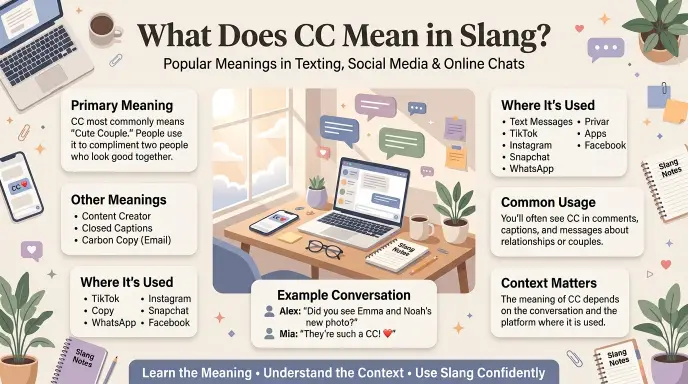
What does CC mean slang? In online conversations, CC can have more than one meaning. The most common slang meaning is “credit card.” However, on social media, people also use CC for “closed captions” or “creator credit,” depending on the context.
The correct meaning always depends on where and how the abbreviation is used.Many people search for what does CC mean slang after seeing it in text messages, TikTok videos, gaming chats, or social media comments. This guide explains the most common meanings of CC, where people use it, if it is rude, and how to understand it correctly in different situations.
Quick Answer: What Does CC Mean Slang?
CC is a short abbreviation with several meanings. In slang, it often means credit card. On social media, it may also mean closed captions or creator credit. Always look at the conversation to understand the correct meaning.
What Does CC Mean in Slang?
The meaning of CC changes with the situation.
In many online chats, CC means credit card.
For example:
- “I forgot my CC at home.”
- “Can I use my CC to pay?”
In these examples, CC clearly means credit card.
However, CC does not always have this meaning. On some platforms, it can stand for something different.
Does CC Have More Than One Meaning?
Yes. CC has several common meanings.
CC Means Credit Card
This is one of the most common slang uses.
People often shorten credit card to CC in text messages and online chats.
CC Means Closed Captions
On TikTok, YouTube, Instagram, and other video platforms, CC often means closed captions.
Example:
- “Please turn on CC.”
Here, the speaker is asking viewers to enable captions.
CC Means Creator Credit
Some creators write CC to give credit to the person who made a video, photo, or design.
Example:
- “CC: @username”
In this case, CC shows who created the content.
Where Is CC Slang Commonly Used?
You can see CC in many online places.
Text Messages
People often use CC instead of typing credit card.
Social Media
Many creators use CC when talking about captions or giving credit.
Online Shopping
People may write CC while discussing payments.
Video Platforms
Viewers often mention CC when talking about subtitles or accessibility features.
Group Chats
Friends sometimes use CC because it is short and easy to type.
How Can You Tell Which Meaning Is Correct?
The easiest way is to look at the full conversation.
For example:
- “My CC was declined.” → Credit card
- “Turn on the CC.” → Closed captions
- “CC to the original artist.” → Creator credit
Reading the complete sentence helps you understand the correct meaning without confusion.
Is CC Slang Rude, Offensive, or Harmless?
CC is harmless. It is simply a short form that saves time while typing.
The abbreviation is not rude or offensive. However, using the wrong meaning can confuse other people.
Here is a simple guide:
| Situation | Is It Appropriate? |
| Text messages | ✅ Yes |
| Social media | ✅ Yes |
| Group chats | ✅ Yes |
| Online shopping | ✅ Yes |
| Workplace chats | ✅ Usually |
| Formal documents | ⚠️ Better to write the full words |
| School reports | ❌ Use the full term instead |
If you are unsure, write the complete phrase instead of using CC.
Why Do People Use CC?
People use CC because it is short and easy to type.
Here are the most common reasons.
To Save Time
Typing CC is much faster than writing credit card or closed captions.
To Keep Messages Short
Short messages are easier to read, especially on mobile phones.
To Match Online Conversations
Many people use abbreviations in chats and social media posts. CC is one of them.
To Give Credit
Some creators write CC before a username to credit the original creator.
Is CC Still Popular?
Yes. CC is still common today.
People use it every day in:
- Text messages
- TikTok comments
- Instagram posts
- YouTube videos
- Online shopping chats
- Community forums
- Group conversations
The meaning depends on the platform and the topic.
Who Commonly Uses CC?
Many different people use CC.
You may see it from:
- Students
- Friends
- Content creators
- Online shoppers
- Video editors
- Social media users
- Office workers
Because CC has several meanings, people from different communities may use it in different ways.
Common Situations Where You May See CC
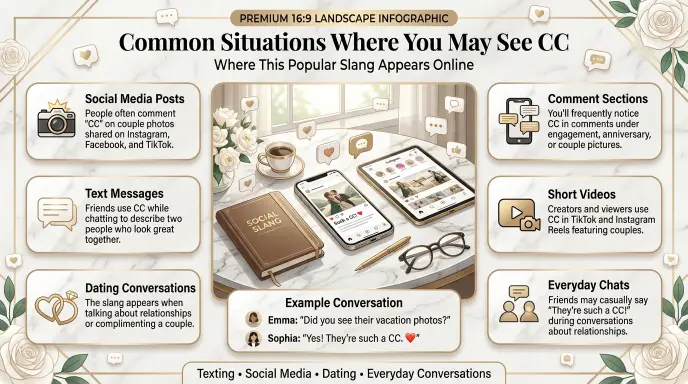
You can find CC in many everyday situations.
- Sending text messages
- Watching online videos
- Reading social media comments
- Buying products online
- Chatting with friends
- Joining online communities
- Sharing creative content
Looking at the full sentence will usually tell you what CC means.
Real-Life Examples of CC Slang
These examples show how CC is used in different conversations.
Text Message: “I left my CC at home.”
Online Shopping Chat: “Can I pay with my CC?”
TikTok Comment: “Please add CC so everyone can follow the video.”
Instagram Post: “CC: @artistname for the original design.”
YouTube Comment: “The CC made this video much easier to understand.”
Each example uses CC in a different way. The sentence makes the meaning clear.
Origin and History of CC
The abbreviation CC existed long before social media.
For many years, people used CC to mean Carbon Copy in letters and emails. Later, new technology gave the abbreviation additional meanings.
As online communication grew, CC also became a common short form for credit card, closed captions, and creator credit. Today, the meaning depends on the platform and the conversation.
Similar Internet Abbreviations
If you understand CC, you may also see these common abbreviations online.
| Abbreviation | Meaning | Common Use |
| CC | Credit Card, Closed Captions, Creator Credit | Texting and social media |
| DM | Direct Message | Social media |
| PM | Private Message | Chats and forums |
| IDK | I Don’t Know | Text messages |
| IMO | In My Opinion | Online discussions |
| FYI | For Your Information | Messages and emails |
| BRB | Be Right Back | Chat conversations |
| TTYL | Talk To You Later | Casual texting |
These abbreviations help people write faster in online conversations.
When Should You Avoid Using CC?
Although CC is easy to use, it is not the best choice in every situation.
Avoid using CC when you are:
- Writing a formal report.
- Completing a school assignment.
- Preparing legal documents.
- Writing official business letters.
- Talking with someone who may not know internet abbreviations.
Writing the full words makes your message clearer.
Better Alternatives to CC
If you want to avoid confusion, use the complete phrase.
Instead of CC, write:
- Credit card
- Closed captions
- Creator credit
- Captions
- Original creator
- Payment card
The full words are easier for every reader to understand.
Frequently Asked Questions
Q1. What does CC slang mean in texting?
CC in texting usually means “Cute Couple.” People use it to compliment two people who look good together.
Q2. What is CC in social media?
On social media, CC commonly means “Cute Couple,” though it can also stand for Content Creator or Closed Captions depending on the context.
Q3. What does CC mean in Gen Z slang?
In Gen Z slang, CC most often stands for “Cute Couple.” It’s commonly used on TikTok, Instagram, and Snapchat.
Q4. What is CC when texting?
When texting, CC usually means “Cute Couple.” It is a quick way to praise a couple.
Q5. What does CC mean for a girl?
If someone calls a girl CC with her partner, it usually means she and her partner make a cute couple. It is generally meant as a compliment.
Q6. What does CC mean in dating?
In dating, CC means “Cute Couple.” It describes two people who look happy or attractive together.
Conclusion
If you have ever wondered, what does CC mean slang, the answer depends on the context. The abbreviation most commonly means credit card, closed captions, or creator credit. Each meaning is correct in the right situation.
The easiest way to understand CC is to read the complete sentence and consider where it appears. Once you know the context, you can quickly understand the intended meaning and use the abbreviation with confidence.
Explore More Slang Articles:
Heffa Slang: What Does Heffa Mean in Slang?
What Is a Hoosier Slang Meaning in Text:The Slang Term’s Origin
Pirate Slang Insults Meaning in Text:Pirate Slang Insults Explained

I am Masson Caldwell, a language enthusiast and content writer at SlangAura. I write about internet slang, texting trends, and modern expressions to help readers understand the evolving world of online language with simple and clear explanations.