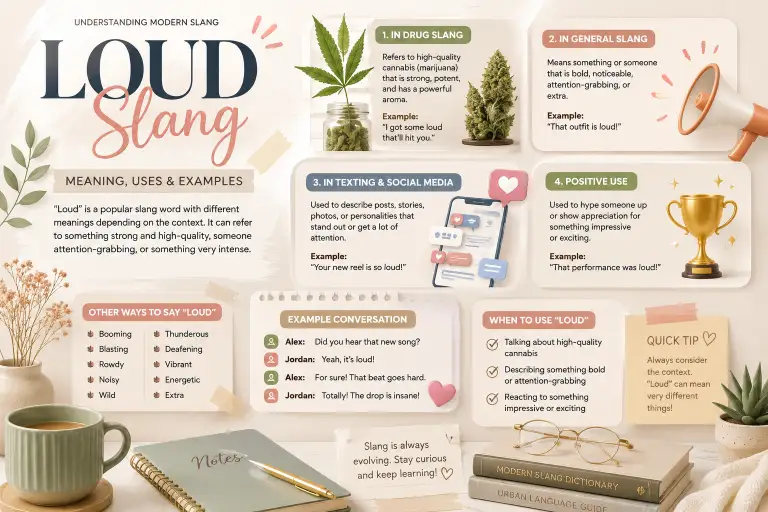
Loud slang usually describes someone or something that is very noticeable, bold, or attention-grabbing. In some conversations, people use loud for a person with a strong personality or bright style.
In other communities, the word has a different slang meaning, so the context is important.Many people search for loud slang after seeing the word on social media, hearing it in songs, or reading it in text messages. This guide explains what loud slang means, where people use it, the different meanings it can have, and how to understand it correctly.
Quick Answer: Loud Slang
Loud slang usually means very bold, easy to notice, or attention-grabbing. Depending on the conversation, it can describe a person’s behavior, clothing, style, or another slang meaning used in specific communities.
What Does Loud Mean in Slang?
In slang, loud often describes someone or something that stands out.
It may refer to a person who speaks confidently, dresses in bright colors, or behaves in a way that quickly gets attention.
For example:
- “His jacket is loud.”
- “She has a loud personality.”
- “That outfit is loud.”
In these examples, loud means bold or easy to notice. It does not always mean making a lot of noise.
Does Loud Have More Than One Slang Meaning?
Yes. Loud has several slang meanings.
Loud Means Bold or Attention-Grabbing
This is the meaning most people hear in everyday conversations.
People may use loud for:
- Bright clothing
- Strong fashion
- Big personalities
- Eye-catching designs
Loud Can Describe Strong Confidence
Sometimes loud describes someone who speaks with confidence and is not afraid to share opinions.
The word does not always have a negative meaning.
Loud Has Another Meaning in Some Communities
In some communities, loud is also used as slang for high-quality cannabis. This meaning is not common in everyday conversations and appears mostly in certain music, online discussions, or subcultures.
The meaning depends on the context, so always read the full conversation before deciding what the speaker means.
Where Is Loud Slang Commonly Used?
People use loud slang in many informal situations.
Social Media
Creators often use loud to describe bold fashion, colorful outfits, or eye-catching content.
Text Messages
Friends may call a shirt, pair of shoes, or hairstyle loud because it stands out.
Music
You may hear loud in song lyrics with different meanings. The context helps you understand which meaning is intended.
Everyday Conversations
People sometimes describe a person’s style or personality as loud.
Online Communities
Some online groups use loud with its community-specific slang meaning. Always consider the topic before deciding what it means.
Who Commonly Uses Loud Slang?
Many people use loud slang, especially in casual conversations.
You may hear it from:
- Teenagers
- Young adults
- Friends
- Fashion lovers
- Social media creators
- Music fans
- Online communities
Different groups may use the word in different ways, so context is always the key to understanding it.
Is Loud Slang Rude, Offensive, or Harmless?
Loud slang is usually harmless. Most people use it to describe a bold style, a strong personality, or something that stands out.
However, the tone can change the meaning. If someone says, “You are too loud,” it may sound like criticism instead of a compliment.
Here is a simple guide:
| Situation | Is It Appropriate? |
| Talking with friends | ✅ Yes |
| Social media | ✅ Yes |
| Text messages | ✅ Yes |
| Fashion discussions | ✅ Yes |
| School conversations | ✅ Usually |
| Workplace | ⚠️ Depends on the context |
| Formal meetings | ❌ Better to avoid slang |
Think about the conversation before using the word.
Why Do People Use Loud Slang?
People use loud slang for several reasons.
To Describe Bold Fashion
A bright outfit or colorful shoes may be called loud.
Example:
- “That jacket is loud.”
To Describe a Strong Personality
Some people call a confident or energetic person loud.
Example:
- “She has a loud personality.”
To Describe Something That Gets Attention
People also use loud for anything that is easy to notice.
Example:
- “That design is loud.”
To Use Community-Specific Slang
In some communities, loud has another slang meaning. The topic of the conversation usually makes the meaning clear.
Is Loud Slang Still Popular?
Yes. Loud slang is still common today.
You may see it in:
- Social media posts
- Fashion videos
- Music lyrics
- Text messages
- Online comments
- Everyday conversations
The meaning depends on the situation.
Can Loud Mean Different Things?
Yes. Loud changes meaning with the context.
Here is a quick comparison.
| Context | Meaning |
| Fashion | Bright or eye-catching |
| Personality | Bold or confident |
| Design | Easy to notice |
| Music discussions | May have a different slang meaning |
| Community-specific conversations | Meaning depends on the topic |
Reading the full conversation helps you understand the correct meaning.
Common Situations Where You May Hear Loud
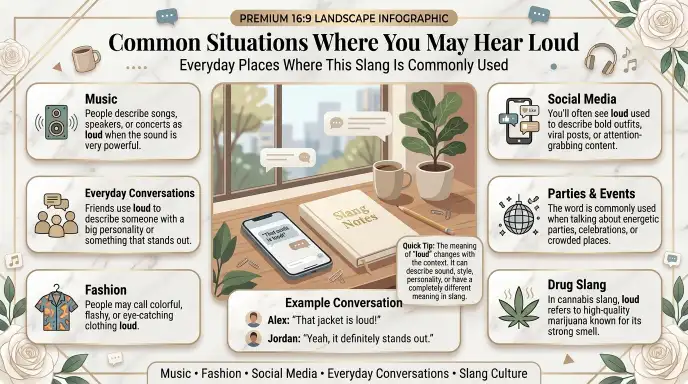
People use loud slang in many casual settings.
- Talking about clothes
- Discussing hairstyles
- Watching fashion videos
- Chatting with friends
- Reading social media comments
- Listening to music
- Sharing photos online
These examples show that loud is mostly an informal word.
Common Misunderstandings About Loud
Many people misunderstand loud slang because the word has several meanings.
Thinking Loud Always Means Noisy
This is not true.
In slang, loud often means bold, bright, or attention-grabbing instead of making a lot of noise.
Believing Loud Is Always Negative
Not always.
Some people use loud as a compliment for a creative style or a confident personality.
Ignoring the Context
The same word can have different meanings in different communities.
Always read the full sentence before deciding what loud means.
Using Loud in Formal Writing
Loud slang is best for casual conversations. In formal writing, choose clear and standard English instead.
Real-Life Examples of Loud Slang
These examples show how loud slang is used in everyday conversations.
Friend: “Your new sneakers are loud. I noticed them right away.”
Text Message: “That shirt is loud, but I like it.”
Social Media Comment: “Her style is loud and creative.”
Fashion Talk: “His outfit is loud, yet it looks great.”
Music Conversation: “The word ‘loud’ means something different in this song.”
Each example shows that loud can have different meanings. The conversation helps you understand the correct one.
Origin and History of Loud Slang
The word loud first described something that made a lot of noise.
Over time, people started using it in a new way. They used loud for bright colors, bold fashion, and strong personalities because these things quickly caught attention.
Later, some music and online communities gave loud another slang meaning. Even so, the idea of something that stands out has remained the same.
Today, loud slang is widely understood in casual conversations and on social media.
Similar Slang Words
If you understand loud slang, you may also hear these similar words.
| Slang | Meaning | Tone |
| Bold | Easy to notice | Positive |
| Flashy | Very bright or stylish | Casual |
| Extra | Over the top | Informal |
| Wild | Unusual or exciting | Casual |
| Fire | Excellent or impressive | Positive |
| Lit | Fun or exciting | Informal |
| Clean | Stylish and neat | Positive |
| Fresh | Modern and fashionable | Positive |
Each word has its own tone. Choose the one that best matches your message.
When Should You Avoid Using Loud?
Although loud slang is usually harmless, it is not suitable in every situation.
Avoid using loud when you are:
- Writing a business email.
- Giving a formal presentation.
- Speaking in a job interview.
- Writing a school report.
- Talking with someone who may not understand slang.
- Discussing sensitive topics where the meaning could be misunderstood.
In these situations, simple words such as bold, bright, or noticeable are often better choices.
Better Alternatives to Loud
If loud does not fit the situation, try one of these words.
- Bold
- Bright
- Colorful
- Noticeable
- Eye-catching
- Stylish
- Confident
- Vibrant
These words are easy to understand and work well in formal writing.
Frequently Asked Questions
Q1. What is loud in drug slang?
In drug slang, “loud” usually refers to strong-smelling, high-quality cannabis (marijuana). The term describes weed with a powerful aroma and potency.
Q2. What does “loud” in slang mean?
In general slang, “loud” means someone or something that is very noticeable, bold, flashy, or attention-grabbing.
Q3. How to say “loud” in a nice way?
You can say energetic, lively, expressive, vibrant, or full of personality instead of “loud.”
Q4. What are some slang terms for loud?
Common slang terms include booming, blasting, rowdy, wild, and noisy.
Q5. How do you say “very loud”?
You can say deafening, booming, thunderous, ear-splitting, or extremely noisy.
Q6. What is a fancy way to say “loud”?
Formal alternatives include resounding, sonorous, thunderous, or vociferous.
Q7. How to say “loud” in a positive way?
Positive alternatives include vibrant, lively, energetic, expressive, or full of life.
Q8. What is a better word for very loud?
A better word for very loud is deafening, booming, thunderous, or piercing, depending on the context.
Q9. What is a simile for loud?
A common simile is “as loud as thunder.” You can also say “as loud as a siren” or “as loud as a jet engine.”
Conclusion
Loud slang usually describes something bold, noticeable, or attention-grabbing. Depending on the conversation, it may refer to fashion, personality, or another community-specific meaning.
The best way to understand loud slang is to focus on the context. Once you know how the word is being used, you can understand it correctly and use it naturally in casual conversations.
You May Also Like:
Dayroom NYC Slang: Meaning, Origin, and How to Use It
I am Emma Collins, a content writer at SlangAura specializing in internet slang, texting abbreviations, and online language. I create simple and accurate guides to help readers understand modern slang easily and confidently.