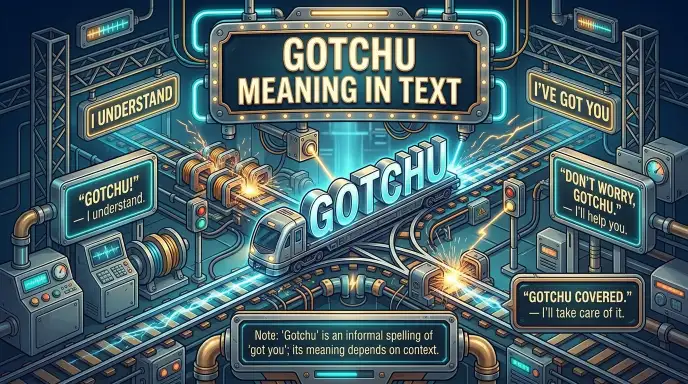
Gotchu meaning in text usually refers to “got you.” People use this informal expression in texting to show understanding, offer help, confirm something, or playfully tell someone they have caught them. For example, if a friend asks you to send some notes and you reply “Gotchu!”, you mean “Sure, I’ll help you.”
Gotchu is a casual spelling of the spoken phrase “got you.” It appears in text messages, online chats, TikTok comments, Snapchat conversations, and Instagram DMs. However, its exact meaning depends on the situation. Sometimes it expresses support, while other times it simply means “I understand.”
Quick Answer: What Does Gotchu Mean in Text?
Gotchu usually means “got you.” It is an informal expression people use to communicate understanding, agreement, help, or playful teasing.
Common meanings include:
- I understand: “Gotchu, I know what you mean.”
- I’ll help you: “Need a ride? Gotchu!”
- I’ve got you covered: “Don’t worry, gotchu.”
- I caught you: “Gotchu trying to sneak out!”
- I understand your point: “Okay, gotchu now.”
The phrase is friendly and casual in most everyday conversations. Its meaning can change depending on the message and the relationship between the people texting.
What Does Gotchu Stand For?
Gotchu is not usually an acronym. Instead, it is a phonetic spelling of “got you,” written the way the phrase often sounds in casual speech.
People use this spelling to make their messages feel relaxed, conversational, and natural. It is especially common when someone wants to reply quickly without typing a complete sentence.
For example:
- “Gotchu!” means “I understand” or “I’ll help you.”
- “I gotchu” means “I have you covered” or “I’m here for you.”
- “Gotchu 😂” may mean “I caught you” or “I fooled you,” depending on the conversation.
Although these expressions are closely related, they do not always communicate exactly the same thing. The surrounding words help clarify the intended meaning.
Common Meanings of Gotchu in Texting
Gotchu can express several ideas in digital conversations. Understanding these meanings makes it easier to interpret short replies.
1. Gotchu Means I Understand
One of the most common uses of Gotchu is to show that you understand what someone has said.
For example:
Person A: “The meeting starts at 10, not 11.”
Person B: “Gotchu, thanks for clarifying.”
Here, Gotchu means “I understand.” It acknowledges the information and shows that the speaker has understood the correction.
People also use it after receiving instructions, explanations, or updates.
2. Gotchu Means I’ll Help You
Gotchu can also express willingness to help someone. In this context, it communicates that the speaker is ready to do something for the other person.
For example:
Friend A: “Can you help me with this assignment?”
Friend B: “Gotchu!”
The reply means “Sure, I’ll help you.” It sounds friendly and supportive, especially when used between friends.
3. Gotchu Means I’ve Got You Covered
Sometimes, Gotchu reassures someone that their needs are taken care of.
For example:
Friend A: “I forgot to bring a pen.”
Friend B: “Gotchu. You can use mine.”
In this situation, the speaker offers a solution. The expression communicates support without requiring a long explanation.
4. Gotchu Means I Caught You
Gotchu can also be used playfully when someone discovers a mistake, catches a joke, or realizes that another person is trying to fool them.
For example:
Person A: “I didn’t eat your fries.”
Person B: “Gotchu! I saw you taking them 😂”
Here, Gotchu means something like “I caught you.” The phrase may sound teasing rather than serious.
5. Gotchu Means I See Your Point
In some conversations, Gotchu shows that someone understands another person’s perspective.
For example:
Friend A: “I can’t come today because I have an exam tomorrow.”
Friend B: “Gotchu, focus on studying.”
The reply acknowledges the explanation and shows acceptance. Depending on the context, it may also communicate that the speaker understands why the other person cannot attend.
How People Use Gotchu in Text Messages
Gotchu is useful in informal conversations because it can communicate a complete response in just one word. However, its meaning changes with the situation.
In Everyday Chats
Friends often use Gotchu to acknowledge information or agree to a request.
Examples:
- “Gotchu, I’ll be there soon.”
- “Okay, gotchu.”
- “Gotchu, thanks for letting me know.”
These replies are casual and direct. They work well when both people already understand the topic being discussed.
In Supportive Conversations
Gotchu may reassure someone that they are not alone or that help is available.
Examples:
- “Don’t stress, I gotchu.”
- “Need anything? I gotchu.”
- “I’ll help you prepare for the test. Gotchu!”
In these examples, the expression communicates care, support, or willingness to help. It can sound warm and encouraging when used sincerely.
In Funny Conversations
People also use Gotchu to tease friends or reveal that they have caught them doing something.
Examples:
- “Gotchu checking my profile 😂”
- “You said you were asleep. Gotchu online!”
- “Gotchu trying to steal my food.”
These messages are often playful. Still, the tone depends on the relationship and if the other person understands the joke.
Gotchu Meaning on TikTok, Snapchat, and Instagram
Gotchu is not exclusive to one social media platform. People use it across different apps, and its meaning generally stays close to “got you.”
Gotchu Meaning on TikTok
On TikTok, Gotchu may appear in comments, captions, videos, or direct messages. Users can write it when they understand a joke, agree with a suggestion, or offer to help someone.
Examples:
- “Need a tutorial? Gotchu!”
- “Gotchu, that trend makes sense now.”
- “You thought nobody noticed? Gotchu 😂”
The first example offers help, the second shows understanding, and the third suggests playful teasing. A specific TikTok trend may give the expression an additional meaning, so the video context matters.
Gotchu Meaning on Snapchat
On Snapchat, people may use Gotchu in chats when confirming plans, responding to a request, or reassuring a friend.
Examples:
- “Send me the location.” : “Gotchu.”
- “Can you save me a seat?” : “I gotchu.”
- “Don’t tell anyone!” : “Gotchu 🤐”
In these examples, the expression communicates agreement or reassurance. However, Gotchu is not an official Snapchat feature or a special abbreviation for streaks.
Gotchu Meaning on Instagram
On Instagram, Gotchu often appears in DMs, comments, and Reels discussions.
Examples:
- “Want me to share your post? Gotchu!”
- “Gotchu, I understand what you mean.”
- “You thought I wouldn’t notice? Gotchu 😂”
The expression can make a reply feel more casual and friendly. Nevertheless, it does not automatically indicate romantic interest or a particular emotion.
Gotchu Meaning From a Guy or Girl
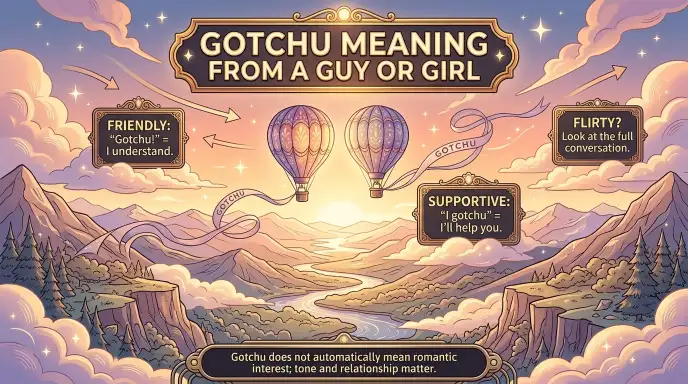
The meaning of Gotchu does not automatically change based on who sends it. A guy or girl may use the expression to acknowledge information, offer assistance, or joke with someone.
When a Guy Texts Gotchu
If a guy replies “Gotchu,” he may simply mean that he understands or will help you.
For example:
You: “Can you remind me about the assignment?”
Him: “Gotchu.”
His reply suggests that he understands your request. It does not necessarily mean he is flirting or has romantic feelings.
When a Girl Texts Gotchu
If a girl sends “Gotchu,” she may be agreeing to something, reassuring you, or acknowledging what you said.
For example:
You: “I’ll send you the pictures tonight.”
Her: “Gotchu!”
She may simply be acknowledging your message. The word alone does not reveal if she is interested romantically.
The key point: Interpret Gotchu through the full conversation rather than assuming the sender’s intentions from one word.
Is Gotchu Flirty or Friendly?
Gotchu can sound friendly, supportive, playful, or occasionally flirty. However, the expression itself is not inherently romantic.
For example, “I gotchu ❤️” may sound affectionate because of the heart emoji and the relationship between the people. Meanwhile, “Gotchu, thanks” is usually a straightforward acknowledgment.
Consider these examples:
- “I gotchu, don’t worry.” : Supportive or reassuring.
- “Gotchu 😉” : Potentially playful or flirty, depending on context.
- “Gotchu, see you later.” : Casual and friendly.
- “Haha, gotchu!” : Often playful or teasing.
Emojis, previous messages, and the sender’s usual communication style can help clarify the tone. Even so, one expression is not enough to determine someone’s feelings with certainty.
Gotchu vs. Got You vs. I Got You
These expressions are closely related, but their spelling and tone differ.
| Expression | Typical meaning | Tone |
| Gotchu | I understand, I’ll help, or I caught you | Very casual |
| Got you | I understand you, caught you, or have you covered | Casual |
| I got you | I’ll help you, support you, or take care of it | Friendly or reassuring |
| Got it | I understand or received the information | Neutral and direct |
| Gotcha | I understand, caught you, or fooled you | Casual and sometimes playful |
The meaning of each expression depends on context. For instance, “Got it” usually emphasizes understanding, while “I got you” can emphasize support or assistance.
Gotchu and gotcha may overlap in casual speech, but they are not always interchangeable. The speaker’s intended meaning and the conversation help determine which interpretation fits.
How to Reply When Someone Says Gotchu
Your response depends on what the other person means. In many cases, you do not need to reply because Gotchu already acknowledges your message.
If They Mean “I Understand”
You can answer naturally:
- “Perfect, thanks!”
- “Great 😊”
- “Exactly.”
- “Glad we’re on the same page.”
If They Mean “I’ll Help You”
A simple thank you works well.
- “Thank you, I appreciate it.”
- “You’re the best!”
- “Thanks for helping me out.”
- “Appreciate you!”
If They Are Teasing You
this conversation is playful, you can respond with humor.
- “Haha, you caught me 😂”
- “Okay, you got me!”
- “No way, how did you know?”
- “I knew you’d notice!”
If You Are Unsure What They Mean
Ask a short follow up question rather than guessing.
- “Gotchu as in you understand?”
- “Wait, what do you mean? 😂”
- “Are you saying you’ll help?”
These replies keep the conversation clear and natural.
Common Mistakes When Understanding Gotchu
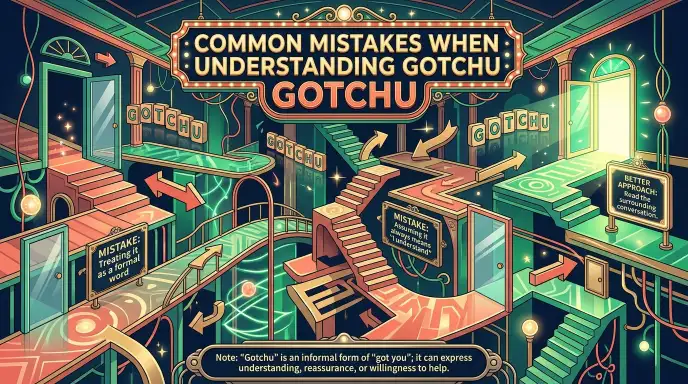
Gotchu is easy to understand in many situations, but a few common mistakes can lead to confusion.
Assuming It Always Means “I Understand”
Gotchu often means “I understand,” but it can also communicate help, reassurance, or playful teasing. For example, “I gotchu” in response to a request usually means the person is willing to help.
Thinking Gotchu Is a Formal Acronym
Gotchu is an informal spelling of “got you,” not a standard acronym with a fixed full form. It is best suited to casual conversations rather than formal business emails or academic writing.
Assuming It Always Means Romance
A message such as “Gotchu ❤️” may feel affectionate, but Gotchu alone does not prove romantic interest. Consider the wider conversation before interpreting it as flirting.
Confusing Gotchu With Got It
Both expressions can show understanding, but they may have different shades of meaning. “Got it” commonly confirms that information has been understood, while “Gotchu” can additionally sound supportive or playful.
Ignoring the Conversation’s Context
The same word can mean different things in different situations. If someone says “Gotchu” after you ask for help, they probably mean they will help. If they say it after discovering a prank, they may mean they caught you.
Real Life Examples of Gotchu Meaning in Text
Here are realistic examples showing how people use Gotchu in everyday conversations.
Example 1: Asking for Help
Friend A: “Can you send me the class notes?”
Friend B: “Gotchu!”
Meaning: Friend B agrees to help by sending the notes.
Example 2: Confirming Plans
Person A: “Meet me outside the library at 4.”
Person B: “Gotchu, see you there.”
Meaning: Person B understands the plan and acknowledges the meeting time.
Example 3: Offering Reassurance
Friend A: “I’m worried I won’t finish this project.”
Friend B: “Relax, I gotchu.”
Meaning: Friend B is offering support or promising to help.
Example 4: Reacting to a Joke
Person A: “You really thought that was my real account?”
Person B: “Gotchu 😂”
Meaning: Depending on the exchange, the person may be admitting that they fooled the other person or were caught in the joke.
Example 5: Talking to a Crush
Person A: “I forgot my charger.”
Person B: “I gotchu, you can borrow mine.”
Meaning: The person is offering help. The action may be friendly or affectionate, but the words alone do not prove romantic interest.
Example 6: Understanding an Explanation
Friend A: “You have to click the blue button first.”
Friend B: “Ohh, gotchu now.”
Meaning: Friend B understands the instructions.
Example 7: Responding to a Secret
Friend A: “Please don’t share this with anyone.”
Friend B: “Gotchu 🤐”
Meaning: Friend B is acknowledging the request and indicating that they understand.
Example 8: Playful Teasing
Person A: “I wasn’t looking at your story.”
Person B: “Gotchu checking it twice 😂”
Meaning: Person B is teasing the other person about viewing their story.
Frequently Asked Questions About Gotchu Meaning in Text
Q1. What does Gotchu mean in text messages?
Gotchu usually means “got you.” It can communicate understanding, willingness to help, reassurance, or playful teasing, depending on the conversation.
Q2. Is Gotchu slang?
Yes. Gotchu is an informal spelling of “got you.” People commonly use it in casual text messages, online chats, and social media conversations.
Q3. What does “I gotchu” mean?
“I gotchu” usually means “I’ve got you covered,” “I’ll help you,” or “I’m here for you.” The exact meaning depends on what the other person needs.
Q4. What does Gotchu mean from a guy?
When a guy texts Gotchu, he usually means he understands, agrees, or will help. The word alone does not prove that he is flirting or romantically interested.
Q5. What does Gotchu mean from a girl?
When a girl texts Gotchu, she may be acknowledging your message, agreeing to a request, or offering reassurance. Context determines the intended meaning.
Q6. Does Gotchu mean I love you?
No. Gotchu does not directly mean “I love you.” It usually means “got you,” although it can sound affectionate in a caring conversation.
Q7. What does Gotchu mean on Snapchat?
On Snapchat, Gotchu generally means “I understand,” “I’ll help,” or “I’ve got you covered.” It is informal slang, not an official Snapchat specific abbreviation.
Q8. What does Gotchu mean on TikTok?
On TikTok, Gotchu is commonly used to acknowledge a comment, offer help, or playfully suggest that someone has been caught. The video or comment thread provides the context.
Q9. Is Gotchu the same as Gotcha?
They have overlapping meanings, but usage can differ. Gotchu is a casual spelling of “got you,” while Gotcha often means “I understand,” “I caught you,” or “I fooled you.”
Q10. How should I reply to Gotchu?
You can reply with “Thanks,” “Perfect,” or “Appreciate it” if the person is offering help. If they are teasing you, a playful response such as “Haha, you caught me!” may fit better.
Conclusion
Gotchu meaning in text is usually “got you,” an informal expression used to show understanding, offer help, provide reassurance, or tease someone playfully. It is common in everyday messaging and across platforms such as TikTok, Snapchat, and Instagram.
The phrase can communicate different things depending on the situation. “Gotchu” may mean “I understand,” while “I gotchu” often suggests that someone is willing to help or has a situation covered. In playful conversations, it may also mean “I caught you.”
Remember that Gotchu is not a formal acronym, and it does not automatically indicate romantic interest. Read the full message and consider the context to understand what the sender intends.
🧩 More Slang Words to Know:
GOT Meaning in Text: Definition, Uses, and Examples

I am Emma Collins, a content writer at SlangAura specializing in internet slang, texting abbreviations, and online language. I create simple and accurate guides to help readers understand modern slang easily and confidently.