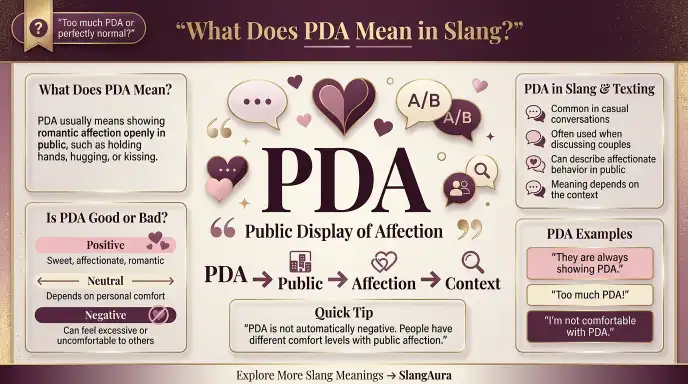
PDA slang usually means “public display of affection,” which refers to romantic affection shown openly in front of other people. It can include holding hands, hugging, kissing, cuddling, or other visible signs of affection.
If you searched what does PDA mean slang, you may have seen the abbreviation in a text, TikTok comment, Instagram post, Snapchat message, or conversation about relationships. PDA is short and easy to type, so people often use it instead of writing the full phrase.
The word itself is not usually negative. The tone depends on how someone talks about the behavior. A person might call a couple’s PDA “cute,” “awkward,” or “too much.” This guide explains the PDA slang meaning, what it stands for, where people use it, and how its meaning changes with context.
Quick Answer: What Does PDA Mean Slang?
PDA means “public display of affection.” In casual texting and social media, it describes romantic affection that people show openly in front of others, such as kissing, hugging, cuddling, or holding hands.
What Does PDA Mean in Slang?
When people ask what does PDA mean slang, they are usually asking about affection between romantic partners.
PDA stands for public display of affection. It describes a couple showing physical or romantic affection where other people can see them.
Common examples include:
- Holding hands
- Hugging
- Kissing
- Cuddling
- Putting an arm around a partner
- Sitting closely together
- Giving a partner a quick kiss in public
The amount of behavior considered PDA can vary from person to person. Some people see holding hands as completely normal. Others may use “PDA” mainly when a couple is being more physically affectionate.
So, PDA does not automatically mean inappropriate behavior. It is simply a term for affection displayed publicly.
What Does PDA Stand For?
PDA stands for Public Display of Affection.
It is an abbreviation made from the first letters of the phrase:
- P = Public
- D = Display
- A = Affection
“Public” means other people can see the behavior. “Display” means the affection is shown openly. “Affection” refers to feelings of love, care, or romantic closeness.
For example:
“They were showing too much PDA.”
This means the speaker thinks the couple was being overly affectionate in front of other people.
Is PDA Slang or an Abbreviation?
PDA is more accurately described as an abbreviation than a slang word.
It is common in casual speech, texting, social media, relationship discussions, and everyday conversations. However, it is not an abbreviation that was created specifically for the internet.
This distinction is useful because some people assume every short expression used online is internet slang. PDA has been used outside social media for years.
You can see it in:
- Text messages
- Dating discussions
- School rules
- Workplace conversations
- Social media posts
- Relationship articles
- Casual conversations
Different Meanings of PDA
PDA can have more than one meaning. The correct definition depends on the topic.
PDA Meaning: Public Display of Affection
This is the meaning most people are asking about when they search for PDA slang.
It describes romantic affection shown openly in public.
Example:
“They were holding hands and kissing. There was a lot of PDA.”
Here, PDA clearly means public display of affection.
PDA Meaning: Personal Digital Assistant
In technology, PDA can also stand for personal digital assistant.
A personal digital assistant was a small electronic device designed to help people manage tasks such as:
- Calendars
- Contacts
- Notes
- Schedules
- Personal information
This technology meaning is older and is much less common in everyday conversations today.
How Can You Tell Which Meaning Is Correct?
Look at the surrounding words.
If the conversation mentions dating, couples, kissing, relationships, or affection, PDA almost certainly means public display of affection.
If the conversation is about old computers, handheld devices, or technology, it may mean personal digital assistant.
Where Is PDA Commonly Used?
PDA appears in many types of casual communication. Its meaning usually stays the same, but the tone can change.
PDA in Texting
PDA is useful in text messages because it saves space.
For example:
“They were doing PDA at dinner 😂”
The sender means the couple was openly affectionate at dinner.
A friend might also text:
“I don’t mind PDA, but that was a lot.”
Here, the person is sharing an opinion about the behavior.
PDA on TikTok
TikTok users may use PDA when talking about couples, dating, relationship videos, or celebrity relationships.
For example:
“Their PDA is actually so cute.”
This sentence gives PDA a positive tone.
Another person might comment:
“That much PDA makes me uncomfortable.”
The abbreviation stays the same, but the opinion changes.
PDA on Instagram
PDA can appear in captions, comments, and discussions about couples.
Example:
“The PDA in this photo is adorable.”
Instagram users may also use the term when discussing celebrity couples or romantic posts.
PDA on Snapchat
Friends may use PDA when talking about people they know.
Example:
“Did you see their PDA at lunch?”
The meaning is still public display of affection.
PDA on Reddit
Reddit discussions may use PDA when people debate relationships, social boundaries, dating habits, or public behavior.
Because Reddit has many different communities, the tone can range from serious discussion to humor.
PDA on Discord
PDA can also appear in casual Discord conversations, especially in communities where friends discuss relationships, dating, or personal experiences.
It is not a Discord-specific term. Discord simply provides another place where people may use the abbreviation.
PDA Usage Across Different Platforms
| Platform | Common PDA context | Typical tone |
| Texting | Talking about couples | Casual |
| TikTok | Couple videos and comments | Casual/playful |
| Couple posts and captions | Positive/casual | |
| Snapchat | Talking with friends | Casual |
| Relationship discussions | Mixed | |
| Discord | Friend conversations | Casual |
| School | Rules or student behavior | Informal/formal |
| Workplace | Professional boundaries | More formal |
The important point is that PDA does not have a different slang meaning on each platform. The abbreviation normally keeps the same meaning, while the context and tone change.
What Counts as PDA?
PDA can cover many types of affectionate behavior.
Mild PDA
These actions are often seen as normal by many people:
- Holding hands
- A quick hug
- Putting an arm around someone
- A short kiss
More Noticeable PDA
People may be more likely to call these actions PDA:
- Long kissing
- Cuddling closely in public
- Repeated romantic touching
- Very intimate behavior around other people
There is no universal line that tells everyone what counts as “too much” PDA. Social norms differ between people, families, cultures, and settings.
For example, holding hands at a park may seem completely normal. The same behavior might feel less appropriate during a formal meeting.
Real-Life Examples of PDA
Example 1: Casual Conversation
A: “Were Mia and Daniel at the party?”
B: “Yeah, they were showing a lot of PDA.”
Here, PDA means the couple was openly affectionate.
Example 2: Text Message
“Their PDA was actually cute.”
The speaker has a positive view of the couple’s affection.
Example 3: Negative Opinion
“I don’t like that much PDA in restaurants.”
The person feels that public affection should be more private.
Example 4: School Conversation
“The school has rules about PDA.”
Here, PDA refers to public displays of affection among students.
Example 5: Social Media
“Why is everyone talking about their PDA?”
The person is asking about public romantic behavior shown by a couple.
Origin and History of PDA
The abbreviation PDA comes from the phrase public display of affection. It was not created by TikTok, Instagram, or Gen Z.
The phrase describes a simple social concept: affection that is displayed where other people can see it. The shortened form became useful in everyday writing and conversation because the three-letter abbreviation is much quicker than repeating the full phrase.
PDA also has an older technology meaning, personal digital assistant. That meaning became associated with handheld electronic devices before smartphones became widespread.
This creates an important context difference. A relationship conversation will usually use PDA to mean public display of affection, while an older technology discussion may use it to mean personal digital assistant.
Is PDA Used by Gen Z?
Yes, Gen Z can use “PDA” in texting and social media, but the term did not originate with Gen Z.
It is better to describe PDA as a widely established abbreviation that remains useful across generations.
You may see it in modern content on TikTok, Instagram, Snapchat, Reddit, and other platforms. However, its continued use does not make it a Gen Z-only slang term.
This is one reason context matters when explaining internet language: a term can be popular online without being newly invented by the generation currently using it.
Is PDA Rude or Offensive?
PDA is not a rude or offensive abbreviation. It is a neutral term for public displays of affection, although people can have different opinions about how much affection is appropriate in public.
For example, saying “They were holding hands” is simply an observation. Saying “They were showing too much PDA” adds the speaker’s personal judgment.
The setting also matters. A quick hug between partners may seem normal at a park or restaurant, while more intimate behavior may make other people uncomfortable in a workplace, classroom, or formal event.
When Should You Avoid Using PDA?
You do not need to avoid the term itself in normal conversation. However, be careful when discussing someone’s relationship or behavior.
Avoid judging someone’s relationship
Calling someone’s affection “too much” can sound critical. If you do not know the people well, a neutral description may be better.
Avoid casual wording in formal situations
In a professional email or official report, write “public display of affection” or describe the specific behavior instead of relying on casual shorthand.
Consider the setting
What counts as acceptable PDA can vary between families, schools, workplaces, cultures, and social groups. A behavior that seems normal to one person may feel uncomfortable to another.
Can You Use PDA at Work or School?
Yes, but the context matters.
In casual conversations with friends, PDA is perfectly natural:
“They got in trouble for PDA at school.”
In formal school communication, teachers may use clearer wording such as “public displays of affection” when discussing rules.
At work, PDA is also understandable, but professional language is usually better for policies or formal complaints. If you are writing to a manager or HR department, explain the behavior clearly instead of using slang.
PDA in Gen Z Slang
PDA is used by Gen Z, especially in texting and social media, but it is not a Gen Z-created slang term.
The meaning remains public display of affection. Gen Z may use it when discussing dating, couples, relationship videos, celebrity posts, or personal experiences.
For example:
“Their PDA is kinda cute.”
Or:
“That was way too much PDA 😭.”
The first sounds positive. The second shows that the speaker feels uncomfortable or amused by the amount of affection.
So when someone searches what does PDA mean slang, the safest answer is still the standard one: public display of affection.
PDA Intimacy: What Does It Mean?
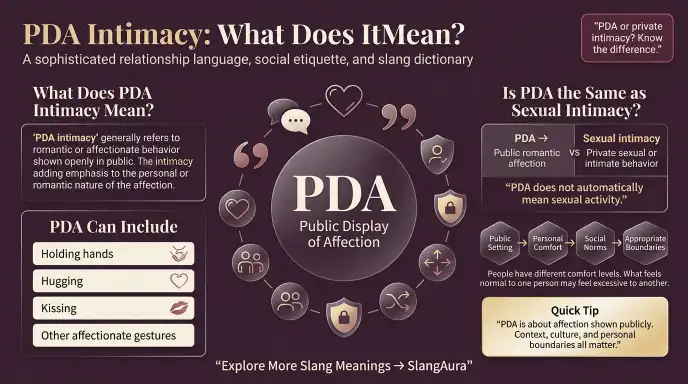
PDA intimacy refers to romantic or physical affection shared openly between partners.
It can range from simple gestures to more intimate behavior.
Common examples
- Holding hands
- Hugging
- Cuddling
- Kissing
- Putting an arm around a partner
- Sitting close together
The word “intimacy” does not automatically mean sexual behavior. It can simply refer to closeness, affection, and romantic connection.
Similar Slang and Related Terms
PDA has several related expressions, but they do not all mean exactly the same thing.
| Term | Meaning | Tone |
| PDA | Public display of affection | Neutral |
| Lovey-dovey | Very affectionate or romantic | Playful |
| Couple goals | A couple people admire | Positive |
| Making out | Kissing in a romantic way | More intimate |
| Cuddling | Holding someone closely | Affectionate |
| Clingy | Needing excessive attention or closeness | Often negative |
| Romantic | Related to love or affection | Neutral |
For example, “lovey-dovey” describes a very affectionate mood, while PDA focuses specifically on affection being shown publicly.
Why Do People Use PDA?
People use PDA because the abbreviation is short, familiar, and easy to understand.
Instead of typing:
“They were showing a public display of affection.”
someone can simply write:
“They were showing PDA.”
It is especially useful in conversations about relationships and social behavior.
The abbreviation also lets people discuss public affection without describing every action in detail.
Common Misunderstandings About PDA
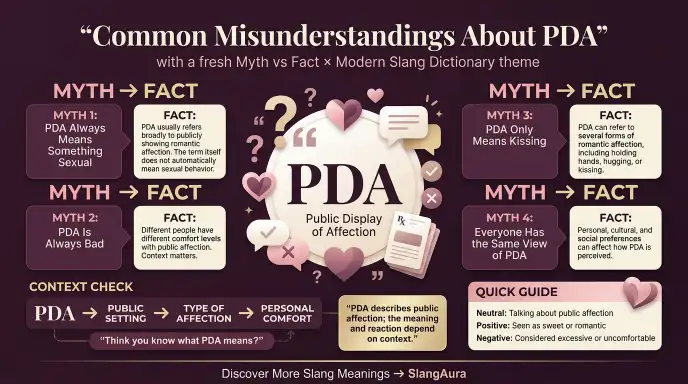
PDA Does Not Only Mean Kissing
Some people think PDA refers only to kissing. That is not correct.
Holding hands, hugging, cuddling, and putting an arm around someone can also be described as PDA.
PDA Is Not Always Negative
The word does not automatically criticize a couple.
Compare:
“Their PDA is adorable.”
with:
“Their PDA is annoying.”
Both sentences use PDA correctly. The difference is the speaker’s opinion.
PDA Is Not Gen Z-Only
Gen Z uses PDA online, but the abbreviation existed before today’s social media platforms.
It is better understood as a common abbreviation that people of different age groups may use.
PDA Can Have Another Meaning
In technology, PDA can mean personal digital assistant.
If the conversation is about old handheld devices or technology, that may be the intended meaning.
Frequently Asked Questions
Q1. What is PDA in Gen Z slang?
In Gen Z slang, PDA usually means public display of affection. It describes couples showing romantic affection openly, such as kissing, hugging, or holding hands.
Q2. What does PDA mean in texting?
In texting, PDA usually stands for public display of affection. People may use it when talking about couples being affectionate in front of others.
Q3. What does PDA mean romantically?
Romantically, PDA means showing affection toward your partner in public. Common examples include kissing, cuddling, hugging, and holding hands.
Q4. What does PDA stand for in Gen Z?
For Gen Z, PDA generally stands for public display of affection. The meaning is the same as the common texting and social-media use.
Q5. What is PDA intimacy?
PDA intimacy refers to physical or romantic affection shared between partners in public. It can include simple gestures like holding hands or more intimate displays like kissing.
Q6. What does “PDA” mean on TikTok?
On TikTok, PDA usually means public display of affection. It is often used in captions, comments, and videos about couples showing affection publicly.
Q7. Is PDA a slang word?
PDA is more accurately called an abbreviation than a slang word. It is widely used in casual speech, texting, social media, and relationship discussions.
Q8. Is PDA always romantic?
When PDA means public display of affection, it usually refers to romantic affection. The specific behavior can range from holding hands to kissing or cuddling.
Q9. What are examples of PDA?
Holding hands, hugging, kissing, cuddling, and putting an arm around a partner are common examples of PDA. The amount considered appropriate depends on the setting and the people involved.
Q10. What does PDA mean on Snapchat?
On Snapchat, PDA usually means public display of affection. Friends may use it when talking about couples or romantic behavior they have seen.
Conclusion
If you are asking what does PDA mean slang, the most common meaning is public display of affection. It describes romantic affection that a couple shows openly in front of other people.
PDA can include simple gestures such as holding hands and hugging, as well as more intimate behavior such as kissing. The term itself is neutral, but people can have different opinions about public affection.
You may see PDA in texting, TikTok comments, Instagram posts, Snapchat messages, Reddit discussions, and everyday conversations. Gen Z uses the abbreviation too, but it is not exclusive to Gen Z.
One final point is worth remembering: PDA can also mean personal digital assistant in technology contexts. If the topic is relationships, dating, or couples, “public display of affection” is almost certainly the intended meaning.
Related Slang Terms:
Bougie Slang Meaning: Definition, Usage, and Examples

I am Emma Collins, a content writer at SlangAura specializing in internet slang, texting abbreviations, and online language. I create simple and accurate guides to help readers understand modern slang easily and confidently.