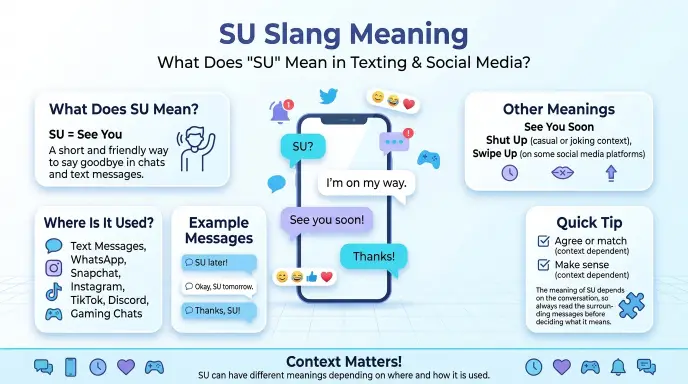
SU slang meaning most commonly stands for “Shut Up.” People use it in text messages, online chats, gaming, and social media. Depending on the conversation, it can sound playful, surprised, annoyed, or rude.
The meaning changes with the tone and the relationship between the people talking.Many users search for “SU slang meaning” after seeing the abbreviation in a text, TikTok comment, Snapchat message, or Discord chat.
Although SU usually means “Shut Up” in slang, it can have other meanings in different contexts. This guide explains the slang meaning, where people use it, if it is rude, and how to respond when you see it online.
Quick Answer: SU Slang Meaning
SU slang meaning usually stands for “Shut Up.” It is an informal abbreviation used in texting and social media. Friends often use it jokingly, but the same abbreviation can sound rude if used during an argument.
What Does SU Slang Meaning Mean?
SU slang meaning refers to the abbreviation “Shut Up.” It is a short way to react to something surprising, funny, unbelievable, or annoying.
Friends sometimes use SU as a playful response after hearing exciting news. In other situations, people use it to tell someone to stop talking. Because of this, the meaning depends on the conversation.
SU as “Shut Up”
This is the most common meaning of SU in internet slang.
Examples:
- “SU, no way you met your favorite singer!”
- “Just SU and listen for a minute.”
- “I can’t believe it. SU!”
SU as a Playful Reaction
Many people do not mean the words literally. Instead, they use SU to show surprise or excitement.
Examples:
- “SU! That’s the best news today.”
- “SU, you’re kidding!”
- “SU! I never expected that.”
Does SU Have a Full Form?
Yes.
In internet slang, SU most commonly stands for “Shut Up.”
However, the abbreviation also has other meanings outside slang. For example, SU may refer to a university, a business term, or a technical abbreviation. Those meanings are different from the slang used in texting and social media.
When you see SU in a casual online conversation, it usually means “Shut Up.”
Different Meanings of SU
SU has more than one meaning. The correct definition depends on where you see it.
| Meaning | Context | Slang? |
| Shut Up | Texting and social media | Yes |
| Swipe Up | Social media marketing | Sometimes |
| University abbreviation | Education | No |
| Other technical meanings | Professional fields | No |
Shut Up
This is the most common slang meaning.
People use it as a reaction to surprising news or to tell someone to stop talking.
Example:
- “SU! I can’t believe you won.”
Swipe Up
On some social media platforms, SU may mean “Swipe Up.” This meaning appears in posts, stories, and marketing content instead of casual conversations.
Example:
- “SU for today’s special offer.”
Where Is SU Slang Meaning Commonly Used?
SU appears most often in fast online conversations where people want to type quickly.
| Platform | How SU Is Used |
| Text Messages | Quick reactions |
| Snapchat | Casual chats |
| TikTok | Comments and replies |
| Discord | Gaming conversations |
| Direct messages | |
| Online Gaming | Team chats |
Text Messages
People use SU when reacting to exciting or unbelievable news.
Examples:
- “SU! You really won?”
- “SU, that’s amazing!”
Snapchat
Friends often use SU in short conversations because it saves time.
Examples:
- “SU! Tell me everything.”
- “SU, I can’t stop laughing.”
Is SU Rude, Offensive, or Harmless?
SU is not automatically rude. The tone depends on the conversation and the relationship between the people involved.
Friends often use SU as a joke after hearing surprising news. However, the same abbreviation can sound disrespectful during an argument or when speaking to someone you do not know well.
Is It Appropriate at Work?
SU is not suitable for professional communication. Business emails, meetings, and workplace messages should use clear and respectful language.
Instead of writing “SU,” you can say:
- “Please let me finish.”
- “Could we stay on the topic?”
- “Let’s discuss this calmly.”
Can You Use It with Teachers or Parents?
It is better to avoid SU when speaking with teachers, parents, or other adults in formal situations. Some people may see it as disrespectful, even if you meant it as a joke.
Using full sentences helps prevent misunderstandings.
Real-Life Examples of SU Slang Meaning
Friends Chatting
Friend A: “I just met my favorite actor.”
Friend B: “SU! That’s unbelievable.”
Text Message
Person A: “I passed my driving test.”
Person B: “SU! Congratulations.”
Snapchat
“SU! You actually did that?”
TikTok Comment
“SU! This is the funniest video I’ve seen today.”
Discord Chat
Player A: “We won the match with one second left.”
Player B: “SU! That was wild.”
Gaming
“SU! We finally beat the final boss.”
These examples show that SU often expresses surprise or excitement when used between friends.
Origin and History of SU
The abbreviation SU became popular as texting and instant messaging grew. People shortened common phrases to type faster, and “Shut Up” became “SU” in many online conversations.
As social media expanded, the abbreviation spread to platforms such as Snapchat, TikTok, Instagram, Discord, and online gaming communities.
Today, many users write SU as a playful reaction instead of a literal command. Even so, the meaning still depends on the context.
Is SU Still Popular?
SU is still used online, but it is less common than many newer internet abbreviations. Some users now prefer emojis, GIFs, or longer reactions instead of short abbreviations.
Similar Slang and Related Terms
| Slang | Meaning | Common Tone |
| OMG | Surprise or shock | Positive |
| FR | For real | Casual |
| NGL | Not gonna lie | Honest |
| IDC | I don’t care | Neutral |
| STFU | Shut the f*** up | Very rude |
| No way | Surprise | Friendly |
SU vs STFU
SU is usually milder than STFU. While SU can sound playful, STFU contains profanity and is widely considered offensive.
SU vs OMG
SU often reacts to surprising news. OMG also expresses surprise, but it does not tell someone to stop talking.
SU vs FR
SU shows surprise or disbelief. FR asks if something is true or emphasizes honesty.
When Should You Avoid Using It?
Avoid using SU when the situation requires respectful or professional language.
Do not use it when:
- Writing business emails.
- Speaking with teachers.
- Talking to customers.
- Writing academic assignments.
- Discussing serious topics.
- Messaging people who may not understand internet slang.
Choose clear alternatives instead, such as:
- “Really?”
- “That’s unbelievable!”
- “Please let me finish.”
- “Could you explain that again?”
These phrases sound more polite and reduce the risk of misunderstanding.
Polite Alternatives to SU
If you are speaking in a formal setting, use polite phrases instead of SU. They sound more respectful and reduce the chance of confusion.
| Informal Slang | Polite Alternative |
| SU | Please let me finish. |
| SU | Could you repeat that? |
| SU | That’s surprising! |
| SU | I can’t believe it. |
| SU | Really? |
| SU | That’s amazing! |
These alternatives work well in schools, workplaces, and professional conversations.
Why Do People Use SU?
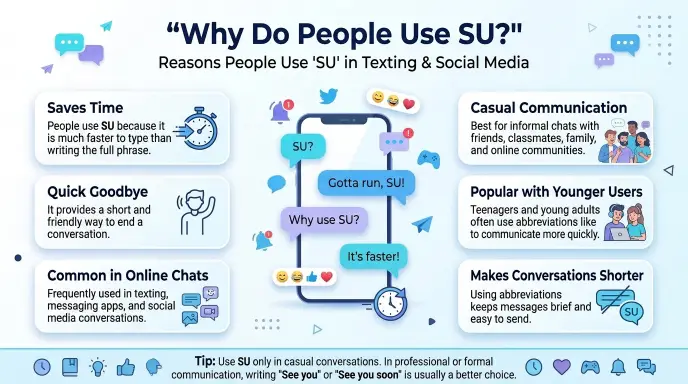
People use SU because it is short and quick to type. It also helps express surprise, excitement, or disbelief without writing a full sentence.
Common reasons people use SU include:
- Reacting to surprising news.
- Showing excitement.
- Responding to a funny message.
- Asking someone to stop talking in a casual chat.
- Saving time while texting.
Common Misunderstandings
SU Always Means “Shut Up”
SU usually means “Shut Up” in slang, but that is not always true. On some social media posts, SU can mean “Swipe Up.” The correct meaning depends on the conversation.
SU Is Always Rude
SU is not always rude. Friends often use it as a playful reaction. However, it may sound disrespectful during an argument or in a formal conversation.
SU Is Used Only in Text Messages
SU appears in text messages, but people also use it on TikTok, Snapchat, Instagram, Discord, and gaming chats.
Frequently Asked Questions
Q1. What does SU mean in texting?
In texting, “SU” most commonly means “Shut Up.” It can be playful between friends or rude, depending on the context.
Q2. What does SU stand for?
SU usually stands for “Shut Up” in chats and social media. In other contexts, it can have different meanings.
Q3. Why does SU mean in text?
In text messages, SU is a short form of “Shut Up.” People use it to react to something surprising, funny, or unbelievable.
Q4. What is the meaning of SU?
The most common meaning of SU is “Shut Up.” However, its meaning can change depending on the conversation.
Q5. Why does SU stand for?
SU stands for “Shut Up” because it uses the first letters of each word. It is a common texting abbreviation.
Q6. Does SU mean shut up?
Yes, SU usually means “Shut Up” in texting and online slang. It can be friendly, joking, or offensive based on the tone.
Conclusion
SU slang meaning most commonly stands for “Shut Up.” Depending on the context, it can express surprise, excitement, disbelief, or frustration. Friends often use it playfully, but the same abbreviation may sound rude in formal conversations.
Understanding the situation is the best way to use SU correctly. If you are chatting with friends, it can sound natural. In workplaces, schools, or professional settings, polite phrases are usually a better choice.
You May Also Like:
TG Slang Meaning: Definition, Uses, and Examples
“Flamingo Slang Meaning: What It Really Means”

I am Emma Collins, a content writer at SlangAura specializing in internet slang, texting abbreviations, and online language. I create simple and accurate guides to help readers understand modern slang easily and confidently.