IMK meaning in text is usually “In My Knowledge.” People use IMK in casual messages when they want to share something based on what they know or understand. It can sound similar to “as far as I know” or “to my knowledge.”
You may see IMK in text messages, group chats, social media comments, and online conversations. For example, someone might write, “IMK, the store closes at 9,” meaning “To my knowledge, the store closes at 9.”
The abbreviation is informal, so its meaning depends on the conversation. It is mainly useful when someone wants to make it clear that they are giving information from their own knowledge rather than claiming absolute certainty.
Quick Answer
IMK means “In My Knowledge” in text and online conversations. It is an informal abbreviation used to introduce information that someone believes to be correct based on what they know.
For example:
“IMK, she already submitted the assignment.”
This means:
“In my knowledge, she already submitted the assignment.”
In everyday English, “to my knowledge” or “as far as I know” may sound more natural. However, IMK can appear in quick chats where people prefer short abbreviations.
IMK Meaning in Text: What Does It Actually Mean?
IMK generally stands for “In My Knowledge.”
It is an informal texting abbreviation. Instead of writing a longer phrase, someone can type three letters to quickly indicate that the information they are sharing comes from their current knowledge.
The phrase can be useful when the sender is not completely certain.
For example:
“IMK, the meeting starts at 10.”
The person is saying that, based on what they know, the meeting starts at 10. They are not necessarily guaranteeing that the information is still correct.
That distinction matters.
If someone writes:
“The meeting starts at 10.”
They sound more direct.
If they write:
“IMK, the meeting starts at 10.”
They are adding a small amount of uncertainty. They are essentially saying, “That is what I know right now.”
Is IMK an Acronym or Abbreviation?
IMK is commonly treated as a texting abbreviation or initialism because each letter represents the beginning of a word.
- I = In
- M = My
- K = Knowledge
Unlike ordinary words, IMK is mainly used in informal digital communication.
You are more likely to see it in a text message or online chat than in formal writing.
IMK vs. “To My Knowledge”
The phrase “to my knowledge” is more natural in standard English.
However, texting often favors speed and convenience. IMK compresses the phrase into three letters.
Compare:
“To my knowledge, he moved last month.”
and:
“IMK, he moved last month.”
Both communicate roughly the same idea. The second version is simply more abbreviated and casual.
Where People Use IMK
IMK can appear in several types of online communication. Its use is especially connected with casual conversations where people already understand common texting abbreviations.
IMK in Text Messages
In private messages, IMK can help someone qualify an answer.
For example:
“IMK, they don’t sell that model anymore.”
Here, the sender is giving information while leaving room for the possibility that their information is outdated.
Another example is:
“IMK, John is still working there.”
The sender may not have checked recently. They are simply sharing what they currently believe.
IMK on Social Media
You may also encounter IMK in comments, replies, or direct messages.
Someone might comment:
“IMK, that feature was removed in the latest update.”
The abbreviation makes the comment sound informal and conversational.
However, not every social media user will recognize IMK immediately. More familiar phrases such as “AFAIK” or “as far as I know” may be easier for some readers to understand.
IMK in Group Chats
Group chats are another place where short abbreviations can be useful.
Suppose friends are discussing an event:
A: “Is the event still happening tomorrow?”
B: “IMK, yes. Nobody said it was canceled.”
Here, IMK tells the group that the answer is based on the sender’s available information.
IMK on WhatsApp and Messaging Apps
IMK can also appear on WhatsApp, Messenger, Discord, and other messaging platforms.
Because these conversations are usually informal, abbreviations can save time.
Still, usage is not universal. Some people may know IMK immediately, while others may need context to understand it.
Real Chat Examples of IMK
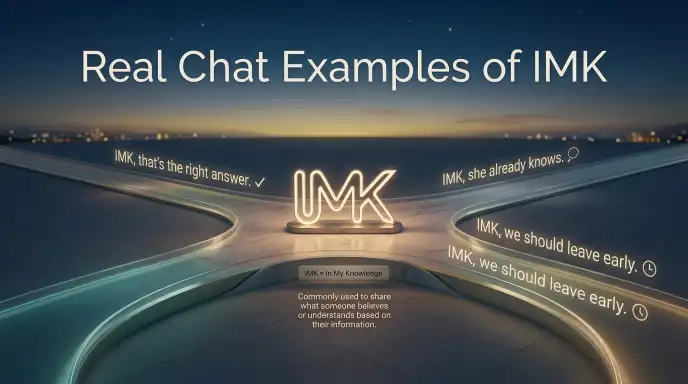
Seeing IMK in realistic conversations makes the meaning easier to understand.
Example 1: Talking About a Schedule
A: “What time does the class start?”
B: “IMK, it starts at 8:30.”
Here, B means that 8:30 is the time they know.
Example 2: Asking About Someone
A: “Does Sarah still live there?”
B: “IMK, yes.”
The sender believes Sarah still lives there based on the information they have.
Example 3: Discussing a Store
A: “Is that restaurant open on Sunday?”
B: “IMK, it is.”
The sender is answering from their knowledge rather than claiming they checked the current schedule.
Example 4: School Conversation
A: “Did the teacher change the deadline?”
B: “IMK, no. It’s still Friday.”
The response suggests that the sender has not heard about a change.
Example 5: Work Chat
A: “Has the report been approved?”
B: “IMK, it hasn’t.”
The sender is sharing the status as they understand it.
Example 6: Online Discussion
A: “Was this feature available last year?”
B: “IMK, it was added later.”
The abbreviation signals that this is the person’s understanding, not necessarily a verified historical fact.
Example 7: Friends Planning a Trip
A: “Are we staying for three nights?”
B: “IMK, we’re staying two.”
The sender is giving the information they currently have.
Example 8: Talking About an App
A: “Can you still download that app?”
B: “IMK, yes.”
The sender believes the app is still available.
Example 9: Event Information
A: “Did they cancel the concert?”
B: “IMK, it’s still going ahead.”
The sender has not heard of a cancellation.
Example 10: Everyday Conversation
A: “Is Mike joining us tonight?”
B: “IMK, he said he would.”
The sender is relying on what Mike previously told them.
How to Reply When Someone Says IMK
When someone uses IMK, you usually do not need a special response. Just understand that they are giving information based on their knowledge.
Your reply can depend on what you want to know next.
Casual Reply
“Okay, thanks!”
This works when you simply want to acknowledge the information.
Friendly Reply
“Got it. I’ll check too.”
This is useful when the information matters and you want to confirm it.
Asking for Confirmation
“Are you sure?”
This works when accuracy is important.
Asking for More Information
“Do you know when that changed?”
You can use this when you want additional context.
Funny Reply
“IMK? So we’re trusting the knowledge department today? 😂”
A playful response can work with close friends.
Neutral Reply
“Thanks for letting me know. I’ll verify it.”
This is appropriate when the information could have changed.
Is IMK Rude or Offensive?
No, IMK is generally not rude or offensive.
It is simply an informal way of qualifying information.
The tone usually depends on the rest of the message rather than the abbreviation itself.
For example:
“IMK, that’s not correct.”
This could sound blunt because of the statement that follows it. However, IMK itself is not an insult.
Similarly:
“IMK, she’s coming later.”
is a neutral statement.
Is IMK Safe for School?
IMK is not offensive, but it is still an informal abbreviation.
For school assignments, essays, applications, or formal communication, writing “to my knowledge” is usually clearer.
A teacher may understand IMK, but that does not make it suitable for academic writing.
Is IMK Appropriate at Work?
In a casual workplace chat, IMK may be understandable.
However, when accuracy or professionalism matters, a complete phrase is often better.
Instead of:
“IMK, the client approved it.”
you could write:
“To my knowledge, the client has approved it.”
The second version makes the qualification clearer.
Who Uses IMK?
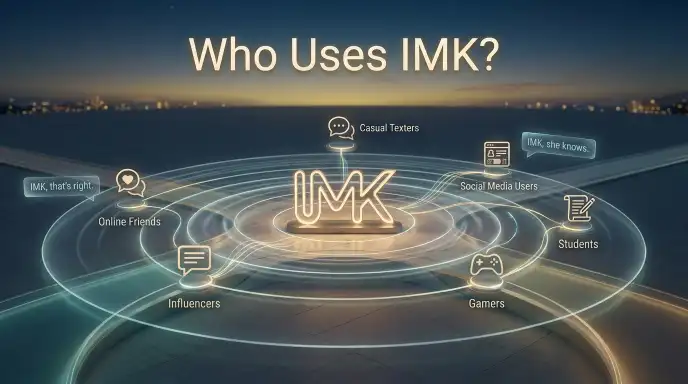
IMK does not belong exclusively to one age group.
People who regularly use texting abbreviations may understand or use it in digital conversations. However, familiarity can vary significantly between communities and platforms.
You should also remember that some abbreviations become popular in small online groups without becoming universal internet slang.
That means seeing IMK online does not necessarily mean everyone will recognize it.
Do Gen Z Use IMK?
Some younger internet users may use IMK, especially in casual texting. However, it is not safe to assume that every Gen Z user knows or uses the abbreviation.
Digital slang changes quickly. One group may prefer IMK, while another may use a more familiar phrase such as “AFAIK.”
Is IMK Common?
IMK is understandable from its letters and context, but it is less universally recognized than major texting abbreviations such as LOL, IDK, BRB, or IMO.
Therefore, context is important.
If you are writing to someone who may not know IMK, saying “to my knowledge” can avoid confusion.
IMK Origin and Internet Usage
There is no single wellknown event that created IMK.
The abbreviation follows a common pattern in digital communication: people shorten longer phrases by using their initial letters.
Texting culture has encouraged this style because shorter messages can be quicker to type.
Expressions such as IDK, IMO, IMHO, and AFAIK became recognizable examples of abbreviated online communication. IMK fits into the same broader habit of compressing phrases.
However, it is important not to treat every abbreviation as having the same level of popularity.
Some internet abbreviations become widely recognized. Others remain relatively niche or contextdependent.
IMK belongs to the latter category more often than highly established terms such as LOL or IDK.
IMK vs. Similar Text Abbreviations
Several texting abbreviations can appear similar because they qualify an opinion or provide information.
| Term | Meaning | Type | Typical Use |
| IMK | In My Knowledge | Text abbreviation | Sharing information based on what you know |
| IDK | I Don’t Know | Initialism | Showing uncertainty or lack of knowledge |
| IMO | In My Opinion | Initialism | Giving a personal opinion |
| IMHO | In My Humble Opinion | Initialism | Giving a personal viewpoint |
| AFAIK | As Far As I Know | Initialism | Qualifying information |
| TBH | To Be Honest | Initialism | Introducing an honest opinion or statement |
The closest comparison is often AFAIK.
For example:
“IMK, the store closes at 8.”
and:
“AFAIK, the store closes at 8.”
Both can communicate that the sender is relying on their current knowledge.
However, AFAIK is a more established internet abbreviation and may be recognized by a wider range of online users.
IMK vs. IDK: What’s the Difference?
These two abbreviations can be confused because both relate to knowledge.
However, their messages are different.
IMK presents information that the sender believes they know.
“IMK, the movie starts at 7.”
IDK directly says that the sender does not know.
“IDK what time the movie starts.”
So, IMK is closer to “this is what I know,” while IDK means “I don’t know.”
That small difference can completely change the meaning of a reply.
IMK vs. IMO: What’s the Difference?
IMK and IMO also serve different purposes.
IMK relates to knowledge:
“IMK, the update came out yesterday.”
IMO relates to opinion:
“IMO, the old design looked better.”
The first statement presents information the sender believes they know.
The second expresses a personal judgment.
This distinction becomes especially useful in online discussions where facts and opinions can easily become mixed together.
IMK vs. AFAIK
AFAIK means “As Far As I Know.”
It is one of the closest alternatives to IMK.
For example:
“AFAIK, the store is still open.”
This has almost the same conversational purpose as:
“IMK, the store is still open.”
However, AFAIK is generally more established as an internet abbreviation.
If your audience is unfamiliar with IMK, AFAIK may be easier for experienced internet users to recognize.
When Should You Use IMK?
IMK works best in casual conversations.
You can use it when:
- You are sharing information from your own knowledge.
- You are not completely certain about a fact.
- You are chatting with friends.
- You are participating in an informal group conversation.
- You want to keep a message short.
- You want to make it clear that your information may need confirmation.
For example:
“IMK, the deadline hasn’t changed.”
This is useful when you believe the information is correct but do not want to present it as an absolute fact.
When Should You Avoid IMK?
Avoid IMK when the audience expects formal or highly precise writing.
That includes:
- Academic essays
- Formal reports
- Job applications
- Official notices
- Professional documents
- Legal or technical writing
In these situations, write the full phrase instead.
For example:
“To my knowledge, the information has not changed.”
This sounds clearer and more professional.
Common Mistakes People Make With IMK
One common mistake is assuming that IMK has exactly the same meaning in every conversation.
Most often, it refers to “In My Knowledge,” but abbreviations can vary between communities.
Another mistake is using IMK when the sender actually means IDK.
For example:
“IMK where she went.”
This could confuse the reader because IMK suggests that the sender has knowledge of where she went.
If the person does not know, IDK would be the appropriate abbreviation:
“IDK where she went.”
Context makes the difference.
Another Mistake: Treating IMK as a Fact
IMK often introduces information that the sender believes to be true. It does not automatically prove that the information is correct.
If the information is important, verify it independently.
For example:
“IMK, the flight leaves at 6.”
If you are actually catching a flight, check the airline information rather than relying only on the abbreviation.
RealWorld Usage Example
Imagine a group of friends planning a birthday dinner.
Friend 1: “Are we meeting at 7?”
Friend 2: “IMK, yes. That’s what Alex said yesterday.”
Friend 3: “I’ll message Alex to confirm.”
This conversation shows why IMK can be useful.
Friend 2 remembers the information but does not present it as guaranteed. Friend 3 decides to confirm the details.
In another situation, someone might ask:
“Is the shop open today?”
A reply such as:
“IMK, yes, but you should check because it’s a holiday.”
is especially practical. The sender shares what they know while recognizing that the circumstances may have changed.
Frequently Asked Questions About IMK
Q1. What does IMK mean in text messages?
IMK usually means “In My Knowledge.” It is an informal texting abbreviation used when someone shares information based on what they currently know.
Q2. What does IMK mean on TikTok?
On TikTok, IMK can mean “In My Knowledge” when used in comments, captions, or messages. Its exact interpretation can depend on the surrounding conversation.
Q3. Is IMK slang?
IMK is better described as an informal texting abbreviation or initialism rather than traditional slang. It is used to shorten “In My Knowledge” in digital conversations.
Q4. Is IMK rude or offensive?
No. IMK is generally neutral and not offensive. It simply indicates that the sender is speaking from their own knowledge.
Q5. How should you reply to IMK?
You can reply naturally based on the situation. Try “Thanks,” “Got it,” “Are you sure?” or “I’ll check too.” There is no special response required.
Conclusion
IMK meaning in text is generally “In My Knowledge.” It is an informal abbreviation that people can use when sharing information based on what they currently know.
The key idea is that IMK can add a small qualification to a statement. Instead of presenting information as completely certain, the sender signals that the information reflects their own knowledge.
You may see IMK in text messages, group chats, social media comments, and other informal online conversations. It is not rude or offensive, although it may be less familiar than abbreviations such as IDK, IMO, or AFAIK.
The context still matters. If someone writes “IMK, the event starts at 8,” they are saying that 8 is the time they believe to be correct. If the information is important, checking the original source is still a good idea.
For casual conversations, IMK can keep messages short. In formal writing, however, phrases such as “to my knowledge” are clearer and more appropriate.
Once you understand that distinction, seeing IMK in a message becomes simple: the sender is basically saying, “This is what I know.”
Up Next!
ILY Meaning in Text: Definition, Uses, and Examples
Zesty Slang Meaning: Definition, Uses, and Examples
LARPing Meaning Slang: Definition, Uses, and Online Examples

I am Masson Caldwell, a language enthusiast and content writer at SlangAura. I write about internet slang, texting trends, and modern expressions to help readers understand the evolving world of online language with simple and clear explanations.