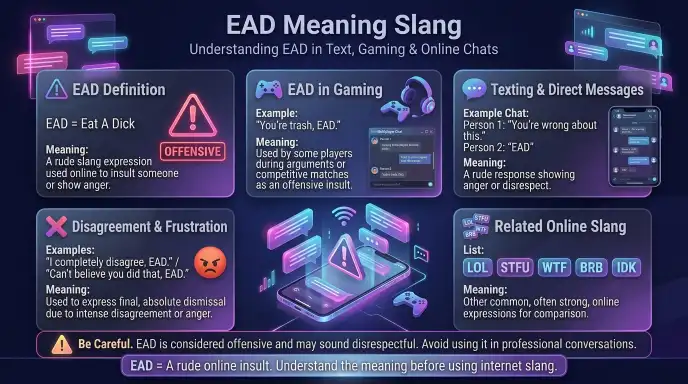
EAD meaning slang usually means “Eat A D*”**, a rude internet phrase used to insult someone or show strong anger. People often use it in online arguments, comments, gaming chats, and casual conversations.
Because it contains offensive language, EAD is considered disrespectful in many situations.Many people search for EAD meaning slang after seeing it in texts, social media comments, or online discussions. This guide explains what EAD means, how people use it, if it is offensive, and when you should avoid using it.
Quick Answer: EAD Meaning Slang
EAD commonly means “Eat A D*.”** It is an insulting slang abbreviation used to dismiss someone, express anger, or tell someone to go away. It is considered rude and inappropriate in most respectful conversations.
What Does EAD Mean in Slang?
In internet slang, EAD is an abbreviation for “Eat A D*.”**
People usually use it as a comeback during an argument or when they feel annoyed with someone.
Examples:
- “You lost the game, EAD.”
- “He replied EAD after the argument.”
The phrase is aggressive and can sound hostile. It is not a friendly expression.
Is EAD a Rude or Offensive Slang Term?
Yes. EAD is rude and offensive slang.
The phrase includes a sexual insult, which makes it inappropriate for many situations.
People may use it:
- As an angry response.
- To insult another person.
- As a joke between close friends.
- During online fights.
However, even when used as a joke, some people may find it offensive.
Does EAD Have More Than One Meaning?
Yes. Like many online abbreviations, EAD can have different meanings depending on the context.
EAD Means Eat A D***
This is the most common slang meaning.
It is mainly used online to insult someone or show frustration.
EAD Can Mean Other Things
In professional or technical contexts, EAD may stand for different terms.
For example:
- Employment Authorization Document
- Estimated Arrival Date
- Electronic Article Surveillance
These meanings are not slang. The topic of the conversation helps identify the correct meaning.
Where Is EAD Commonly Used?
EAD slang is mostly found in informal online spaces.
Gaming Chats
Players may use it during competitive arguments.
Example:
- “You lost again, EAD.”
Social Media
People may use it in comments or replies during online disagreements.
Text Messages
Some friends may use it jokingly, but it still carries a rude tone.
Online Forums
Users may write EAD during debates or heated discussions.
Because of its offensive meaning, it is not suitable for every online space.
Why Do People Use EAD?
People use EAD for different reasons.
Common reasons include:
- To insult someone.
- To show anger.
- To end an argument.
- To make a harsh joke.
- To appear confident during a disagreement.
The meaning and impact depend on the relationship between the people and the situation.
Is EAD Slang Rude, Offensive, or Harmless?
EAD slang is rude and can be offensive. It is not a harmless abbreviation because it contains a sexual insult.
The level of offense depends on the situation.
For example:
- Between close friends, some people may use it as a joke.
- During an argument, it sounds aggressive.
- Toward strangers, it can be disrespectful.
Here is a simple guide:
| Situation | Is EAD Appropriate? |
| Close friends joking | ⚠️ Depends on the relationship |
| Online arguments | ❌ Often rude |
| Workplace chats | ❌ Not appropriate |
| School conversations | ❌ Avoid |
| Gaming with strangers | ❌ Can cause conflict |
| Formal writing | ❌ Never use |
It is best to avoid EAD when you want to communicate respectfully.
Is EAD Still Popular?
Yes. EAD slang is still seen online, especially in spaces where people use quick and aggressive replies.
You may find it in:
- Gaming communities
- Social media comments
- Memes
- Online arguments
- Casual chats
However, many people avoid using it because of its offensive meaning.
Who Commonly Uses EAD?
People who use EAD are often active in informal online spaces.
It may appear among:
- Gamers
- Internet users
- Meme communities
- Teenagers and young adults
- People in online debates
The abbreviation is more common in casual online communication than in real-life conversations.
Common Situations Where You May See EAD
People usually use EAD in heated or joking situations.
During Online Arguments
Example:
- “You have no idea what you are talking about. EAD.”
Here, the phrase is used as an insult.
In Competitive Gaming
Example:
- “You lost the match. EAD.”
Here, it is used as a rude victory message.
Between Friends
Example:
- “You ate my snacks again? EAD 😂”
Some friends may use it jokingly, but the phrase still has an offensive meaning.
Common Misunderstandings About EAD
Many people misunderstand EAD because abbreviations can hide strong meanings.
Thinking EAD Is a Friendly Phrase
It is not usually friendly.
Even when used as a joke, it can offend someone.
Thinking All Online Slang Is Safe
Not every internet abbreviation is harmless.
Some slang terms carry insults or aggressive meanings.
Confusing EAD With Professional Abbreviations
In work or official settings, EAD may have completely different meanings.
Always check the context before understanding the abbreviation.
Can You Use EAD Everywhere?
No. EAD is not suitable for most situations.
Avoid using it in:
- Professional emails.
- School assignments.
- Workplace conversations.
- Formal discussions.
- Conversations with people you do not know well.
Using respectful words helps prevent misunderstandings and conflicts.
Better Alternatives to EAD
If you want to express frustration without being offensive, use these alternatives:
- Leave me alone.
- I disagree.
- Please stop.
- That is not helpful.
- I am done with this conversation.
- I do not agree with you.
These phrases communicate your feelings without using an insult.
Real-Life Examples of EAD Slang
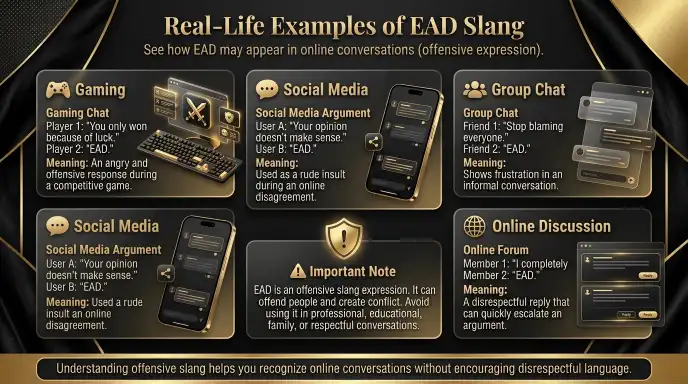
These examples show how EAD slang may appear in online conversations.
Gaming Chat:
“That was a lucky win. EAD.”
Online Argument:
“Stop commenting on my post. EAD.”
Friend Conversation:
“You finished my food again? EAD 😂”
Social Media Reply:
“Someone wrote EAD after disagreeing with another user.”
These examples show that EAD is mostly used as a rude comeback, insult, or joke between people who know each other well.
Origin and History of EAD
The abbreviation EAD became popular as online communication grew.
People started shortening longer phrases to type faster in chats, forums, and social media. Like many internet abbreviations, EAD spread through informal online spaces where quick reactions and strong expressions are common.
The exact first use of EAD slang is difficult to confirm. However, it became more visible through online arguments, gaming communities, memes, and social media conversations.
Similar Slang Terms
If you understand EAD, you may also see other internet expressions used during arguments.
| Slang | Meaning | Tone |
| GTFO | A rude way to tell someone to leave | Very offensive |
| STFU | A rude way to tell someone to be quiet | Offensive |
| IDC | I Don’t Care | Dismissive |
| SMH | Shaking My Head | Disapproval |
| LMAO | Laughing | Casual |
| LOL | Laughing Out Loud | Friendly |
Some of these terms are less aggressive than EAD, while others can also be offensive.
When Should You Avoid Using EAD?
You should avoid using EAD in most respectful conversations.
Do not use it when:
- Talking with teachers or parents.
- Writing professional messages.
- Communicating with customers.
- Applying for jobs.
- Speaking with people you do not know.
- Trying to solve a disagreement calmly.
The phrase can quickly make a conversation more negative.
Polite Alternatives to EAD
If you want to express frustration without insulting someone, try these options:
- “I disagree.”
- “Let’s end this conversation.”
- “Please stop.”
- “I do not want to discuss this.”
- “I have a different opinion.”
- “Let’s move on.”
These alternatives help you communicate clearly without creating unnecessary conflict.
Frequently Asked Questions
Q1: What does EAD slang mean?
EAD slang usually means “Eat A Dick.” It is an offensive phrase used online to insult someone or show anger. It is similar to saying “go away” in a very rude way.
Q2: What does EAD stand for?
EAD can have different meanings depending on the context. In slang and texting, EAD commonly stands for “Eat A Dick.” In other fields, it may have completely different meanings.
Q3: What does EAD stand for in gaming?
In gaming chats, EAD usually means “Eat A Dick” and is used as a rude insult during arguments or competitive conversations. Gamers may use it to mock opponents.
Q4: What does “ed” mean in slang?
“Ed” does not have one fixed slang meaning. Its meaning depends on the conversation. In some online contexts, it can be a shortened form of words, names, or specific terms.
Q5: What does F * ED up mean?
“F*ed up” is a slang phrase meaning something is wrong, messed up, unfair, shocking, or difficult. It can describe a bad situation, mistake, or surprising event.
Q6: What does ED mean in TikTok?
On TikTok, ED can have different meanings depending on the topic. It is often used as an abbreviation for terms like “edit” in video content, while some communities use it for other meanings.
Q7: What is ED in teenagers?
Among teenagers, ED may refer to “eating disorder” when discussing health and mental wellness topics. It can also have other meanings depending on the conversation.
Q8: What’s ED in text?
In texting, ED can mean different things based on context. Common meanings include “edit,” while some users may use it as an abbreviation for other phrases.
Q9: What does ED stand for in a relationship?
In relationship conversations, ED can sometimes refer to “emotional distance” or other personal abbreviations. The exact meaning depends on how someone uses it in the message.
Conclusion
If you were searching for EAD meaning slang, the most common meaning is “Eat A D*.”** It is an offensive internet abbreviation often used in arguments, gaming chats, and online conversations.
The meaning of EAD depends on the context, but its slang use usually carries a rude tone. It is best avoided in professional, school, and respectful conversations. Using clearer and kinder words can help keep conversations positive.
More Internet Slang Guides:
Panther Slang: What It Means and How It’s Used

I am Masson Caldwell, a language enthusiast and content writer at SlangAura. I write about internet slang, texting trends, and modern expressions to help readers understand the evolving world of online language with simple and clear explanations.